How to Reduce Your Brain Tumor Risk
It’s a completely understandable question. Brain tumor diagnoses are frightening. The desire to do something — anything — to reduce the chance of facing one is entirely human.
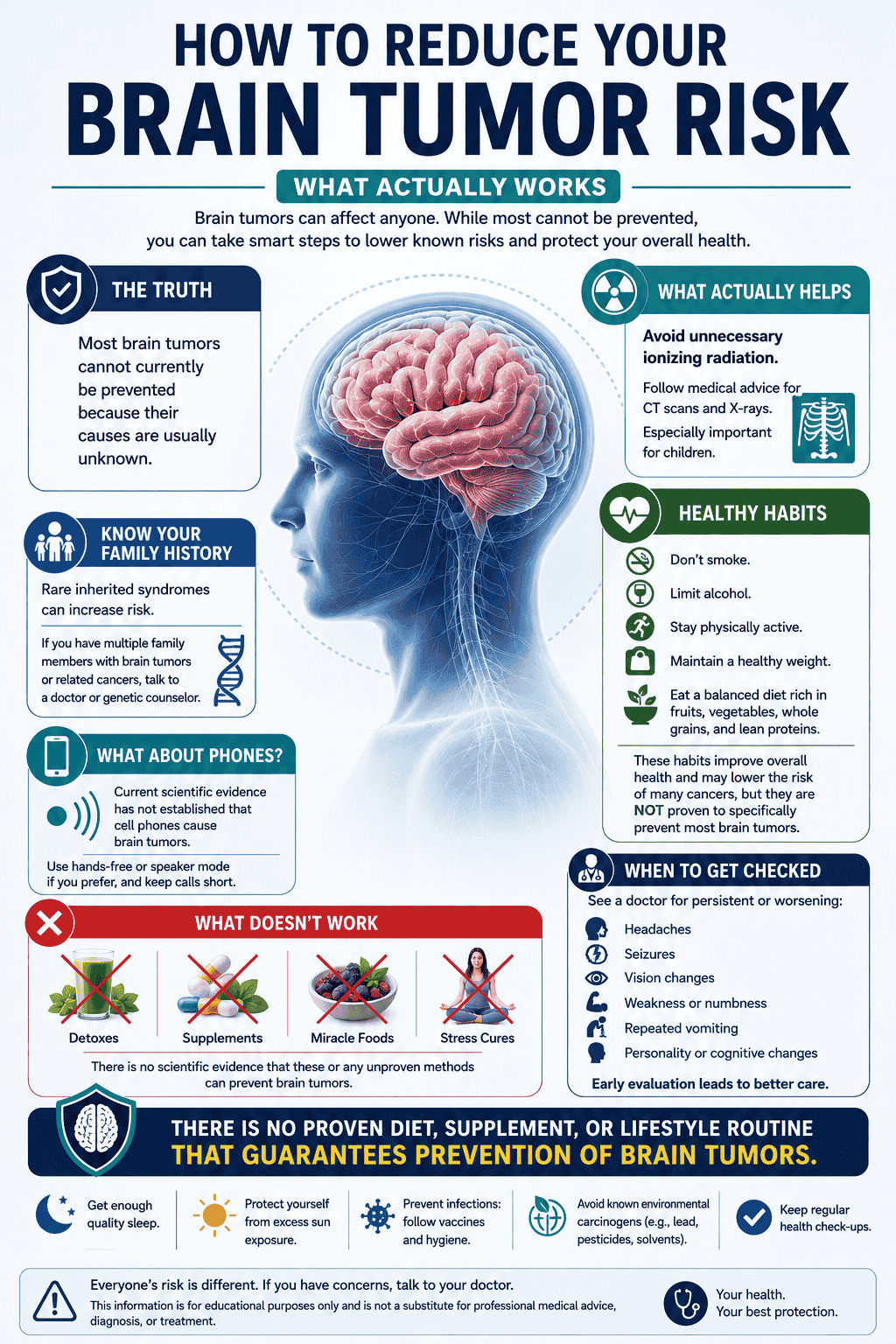
The honest answer requires holding two truths simultaneously. Most brain tumors don’t have clearly preventable causes. And several evidence-based practices genuinely do reduce risk or support overall brain health in ways that matter.
This article gives you both truths — without false reassurance and without unnecessary alarm.
Understanding What Can and Cannot Be Prevented
The most common primary brain tumors — gliomas and meningiomas — develop primarily through genetic mutations that accumulate over time. Age is the most consistent risk factor for most adult brain tumors. Rare inherited genetic syndromes account for approximately 5% of cases.
None of these primary drivers are preventable through lifestyle choices. You cannot prevent aging. You cannot change inherited genetics. You cannot prevent the random cellular errors that accumulate over decades.
What you can meaningfully influence is a smaller set of factors — primarily around radiation exposure and certain lifestyle behaviors that support immune function and general health.
Be skeptical of any source claiming brain tumors can be reliably prevented through supplements, special diets, or wellness practices. The evidence doesn’t support such claims.
What You Can Actually Do
1. Minimize Unnecessary Medical Radiation to the Head
Ionizing radiation is the strongest known environmental risk factor for brain tumors. Therapeutic radiation to the head — delivered as medical treatment — is the primary documented source of radiation-related brain tumor risk.
This doesn’t mean avoiding necessary imaging. CT scans, X-rays, and other diagnostic imaging provide essential medical information that often outweighs the small radiation risk involved. But unnecessary radiation should be avoided.
Ask your doctor whether radiation-based imaging is specifically necessary for your situation, or whether MRI — which uses no radiation — would provide equivalent information. For children especially, following established pediatric imaging guidelines that minimize radiation dose matters significantly. Children’s developing tissues are more sensitive to radiation effects than adult tissue.
Avoid unnecessary dental X-rays. Dentists who recommend annual full-mouth X-rays for low-risk patients without specific indications may be exceeding what evidence supports. Discuss the frequency with your dentist.
2. Know Your Family History and Act on It
Certain inherited genetic syndromes significantly elevate brain tumor risk — neurofibromatosis types 1 and 2, Li-Fraumeni syndrome, Von Hippel-Lindau disease, and others. If multiple family members across generations have developed brain tumors — particularly at young ages — or if your family history combines brain tumors with other unusual cancers, genetic counseling is appropriate.
Identifying an inherited syndrome doesn’t prevent tumors from developing. It does allow for surveillance — regular monitoring that catches tumors when they’re smaller and more treatable. For families with known hereditary syndromes, this surveillance translates into meaningful early detection benefit.
3. Protect Occupational Radiation Exposure
People working in environments with significant ionizing radiation exposure — certain industrial, medical, or nuclear settings — should follow established radiation protection guidelines strictly. Dosimetry monitoring, appropriate shielding, distance from radiation sources, and regulatory compliance all reduce cumulative occupational exposure.
Workers in radiation-associated occupations who haven’t been briefed on current radiation protection guidelines should raise this with their occupational health department.
4. Support General Immune Health
Severely compromised immune function — from HIV infection, organ transplantation requiring immunosuppressive medications, or other causes — elevates risk of certain brain tumors, particularly primary central nervous system lymphoma.
For people with HIV, maintaining viral suppression through antiretroviral therapy dramatically reduces the immune compromise that elevates lymphoma risk. This is one of the clearest examples where a specific health behavior — medication adherence — reduces brain tumor risk in a definable population.
For the general population, supporting overall immune function through adequate sleep, stress management, regular physical activity, and nutritious eating contributes to general health rather than specifically preventing brain tumors. But immune health matters broadly.
Lifestyle Factors With Possible Protective Effects
The following factors show some evidence of association with reduced brain tumor risk, though the evidence is less definitive than for radiation avoidance.
Physical Activity
Several studies have found associations between higher levels of physical activity and reduced brain tumor risk — particularly for meningioma. The biological mechanisms plausibly involve reduced inflammation, better immune function, and hormonal effects.
The evidence isn’t strong enough to say that exercise definitively prevents brain tumors. It’s consistent enough — combined with the extensive evidence that physical activity reduces risk of many other cancers and supports overall health — to make regular exercise a genuinely worthwhile habit.
Current recommendations for general health and cancer risk reduction suggest at least 150 minutes of moderate activity or 75 minutes of vigorous activity weekly. Walking counts. Swimming counts. Dancing counts. The type matters less than the consistency.
Anti-Inflammatory Diet
Chronic inflammation is implicated in cancer development across multiple tumor types. Dietary patterns that reduce chronic inflammation may theoretically reduce cancer risk, though specific evidence for brain tumors is limited.
The Mediterranean dietary pattern — emphasizing vegetables, fruits, whole grains, legumes, fish, and olive oil while minimizing processed foods and red meat — shows the strongest evidence base for anti-inflammatory effects and overall cancer risk reduction.
Adopting this pattern supports general health and likely contributes modestly to reduced risk across multiple cancer types. Specific claims about individual foods “preventing” brain tumors should be viewed skeptically.
Maintaining Healthy Body Weight
Obesity associates with elevated risk of multiple cancer types. Some studies suggest associations between obesity and meningioma risk. Maintaining healthy body weight through diet and physical activity supports general health and contributes to risk reduction across multiple conditions.
Not Smoking
Smoking is not established as a direct brain tumor risk factor in the way it causes lung cancer. However, smoking affects vascular health, immune function, and DNA integrity in ways that contribute to overall cancer risk. Not smoking supports general cancer risk reduction and overall health regardless of its specific brain tumor implications.
Things That Will Not Prevent Brain Tumors
The internet offers an extensive list of supplements, special diets, and practices claimed to prevent brain tumors. Honesty requires addressing these directly.
No supplement prevents brain tumors. Curcumin, green tea extract, vitamin D megadosing, antioxidant cocktails — none have proven preventive effects for brain tumors in properly conducted human trials.
Avoiding mobile phones does not reduce brain tumor risk. Decades of research have found no consistent association between mobile phone use and brain tumor incidence. Limiting phone use will not meaningfully affect your brain tumor risk.
Detox programs and cleanses have no documented brain tumor prevention benefit. The concept of “toxin removal” through special protocols isn’t supported by human physiology — the liver and kidneys handle this function continuously without assistance.
Alkaline diets do not change brain tumor risk. The body tightly regulates blood pH regardless of dietary choices. Cancer cells do not “die in alkaline environments” in any clinically meaningful way that dietary manipulation can achieve.
Special “cancer-fighting” foods consumed in isolation don’t prevent brain tumors. Broccoli, blueberries, and turmeric have genuine nutritional value as part of a varied diet. Consuming them in large quantities as a cancer prevention strategy isn’t supported by clinical evidence.
Early Detection Is Not Prevention — But It Matters
Some people use “prevention” to mean catching brain tumors early. This is technically detection, not prevention — but the practical importance is similar.
Taking neurological symptoms seriously and pursuing evaluation promptly gives the best chance of diagnosing a brain tumor at an earlier, more treatable stage. Symptoms worth evaluating include persistent new headaches with morning worsening, first-time seizures, unexplained progressive neurological changes, and vision changes unexplained by eye examination.
People with known inherited syndromes that predispose to brain tumors should follow recommended surveillance imaging schedules. Early detection through surveillance genuinely improves outcomes for these populations.
Routine brain MRI screening for people without symptoms or elevated risk factors isn’t currently recommended — the cost, inconvenience, and potential for false positive findings outweigh benefits in average-risk populations. But prompt evaluation of genuine symptoms is always worthwhile.
Accepting Uncertainty While Doing What You Can
The most difficult aspect of brain tumor prevention is accepting how limited individual control actually is. Most risk comes from factors — age, random genetic errors, biology — that no lifestyle choice significantly alters.
This can feel disempowering. It’s more accurately understood as honest. Doing everything right — exercising, eating well, avoiding unnecessary radiation, not smoking — reduces risk meaningfully across multiple health conditions while providing no guarantee against brain tumors specifically.
Living well is the best available strategy. Not because it guarantees protection, but because it supports health across the widest range of outcomes — including conditions far more common than brain tumors — while the truly preventable risk factors are avoided.
A Final Word
The reader who asks “what can I do” deserves a real answer — not false reassurance about supplements that don’t work or false despair about nothing mattering.
The real answer is: minimize unnecessary medical radiation, know your family history and act on it, stay physically active, eat an anti-inflammatory diet, maintain healthy weight, don’t smoke, support immune health, and take persistent neurological symptoms seriously.
These practices reduce risk meaningfully across many health conditions. They’re worth doing for that reason — and for the quality of daily life they support — whether or not they ultimately affect brain tumor risk specifically.
For more information about brain tumor risk reduction, visit the
American Cancer Society Brain Tumor Prevention page or the
Mayo Clinic Brain Tumor resource.
Disclaimer: This article serves educational and informational purposes only. It does not constitute medical advice. Consult a qualified healthcare professional for guidance specific to your individual health situation.