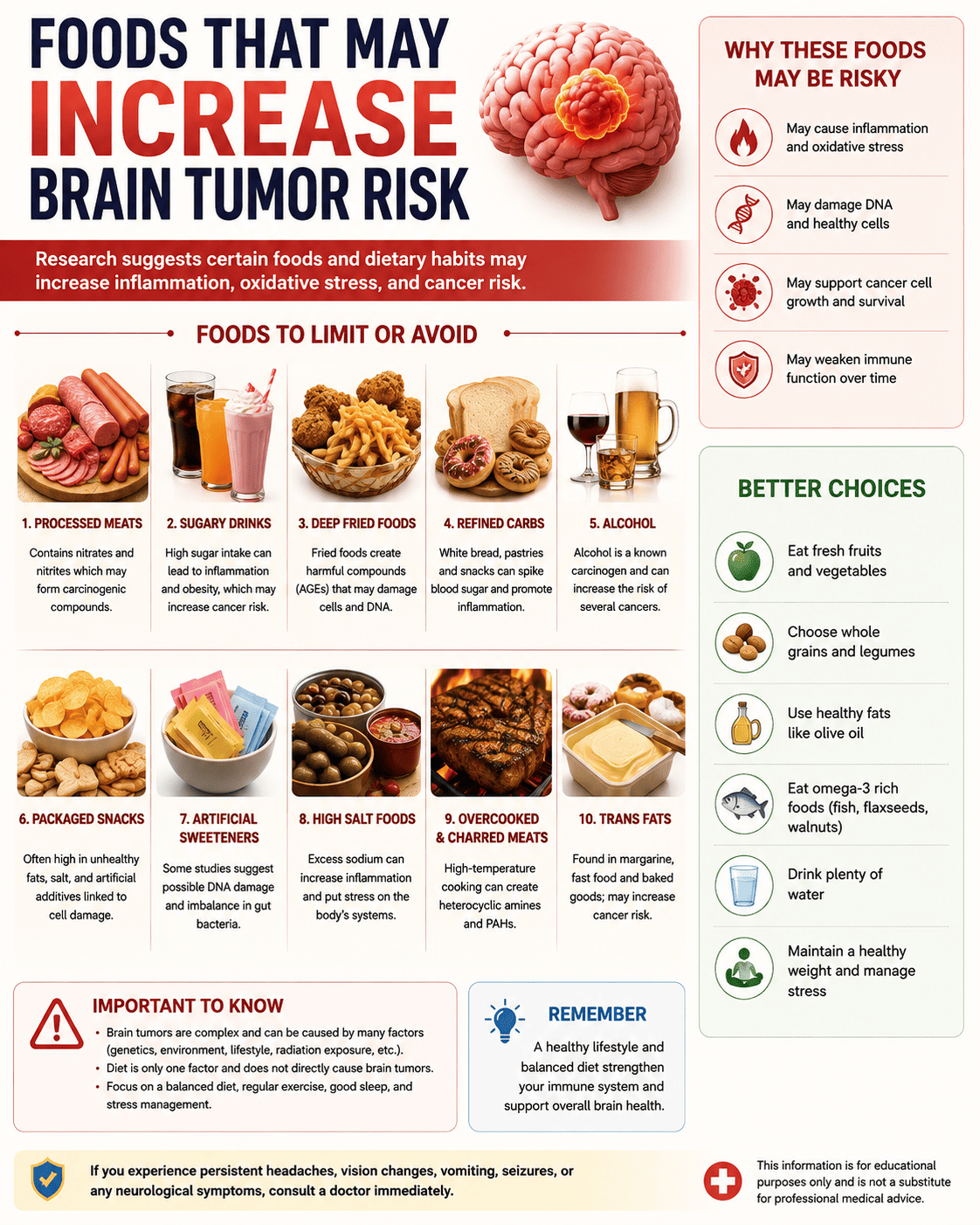
Foods That May Increase Brain Tumor Risk: What Research Shows
Processed snacks. Canned foods. Anything with preservatives. She’d read online that these things “cause brain tumors” and felt she had to do something — both to help her husband and to protect herself and their children.
Her instinct to take control was completely understandable. Her execution was based on a mix of genuine research findings and significant internet exaggeration.
The relationship between diet and brain tumor risk is real but more nuanced than most online sources suggest. Some dietary factors do associate with elevated risk in research studies. Many claimed dietary causes have little or no credible evidence behind them. And the overall contribution of diet to brain tumor risk is much smaller than the contribution of uncontrollable factors like age and genetics.
This article explains what research actually shows — honestly, without exaggeration in either direction.
Important Context Before Diving In
Studying diet and cancer is methodologically difficult. People eat complex, varied diets over decades. Isolating the effect of any single food or ingredient requires large studies with careful methodology. Recall bias — people’s inaccurate memory of what they ate — affects many dietary studies. Confounding factors — where people who eat certain foods also have other habits that affect risk — complicate interpretation.
The associations described in this article come from epidemiological studies — research observing patterns across populations. These studies identify correlations, not necessarily direct causes. Keep this in mind throughout.
Additionally, brain tumor risk overall is relatively low. Even dietary factors that increase relative risk by 20% or 30% translate to very small absolute risk increases given the low baseline rate.
Processed Meats and Nitrate-Containing Foods
Processed meats — hot dogs, sausages, bacon, ham, deli meats, and similar products — have the most consistent dietary association with brain tumor risk in published research.
The proposed mechanism involves N-nitroso compounds (NOCs). These chemicals form in the body from nitrites — used as preservatives in processed meats — reacting with proteins during digestion. NOCs are known carcinogens in animal studies and have been linked to several cancers in human research.
The brain tumor connection received particular attention from studies of maternal diet during pregnancy. Several studies found associations between maternal consumption of processed meats during pregnancy and childhood brain tumor risk in offspring. The concern is that N-nitroso compounds may cross the placenta and affect developing fetal brain tissue.
Adult consumption of cured meats has shown associations with glioma risk in some studies — though findings aren’t entirely consistent across all research. The International Agency for Research on Cancer (IARC) classifies processed meats as Group 1 carcinogens — established human carcinogens — primarily based on colorectal cancer evidence, with brain tumor evidence considered supporting.
Practical implication: moderating processed meat consumption — particularly for pregnant women — is a reasonable evidence-based dietary adjustment. This doesn’t mean eliminating occasional bacon or deli sandwiches causes meaningful risk increase. It means that regular heavy consumption of cured and preserved meats is worth reducing.
Alcohol
Alcohol’s relationship to brain tumors is less established than its relationship to other cancers — liver, breast, colorectal — where evidence is clear and consistent.
Some studies suggest modest associations between heavy alcohol consumption and certain brain tumor types. The biological plausibility involves alcohol’s effects on DNA methylation, oxidative stress, and immune function — all mechanisms relevant to cancer development.
However, the evidence for alcohol specifically increasing brain tumor risk is less consistent and less strong than for other cancers. Moderate alcohol consumption doesn’t appear to meaningfully elevate brain tumor risk in most studies.
The general cancer risk reduction argument for limiting alcohol consumption applies — alcohol is established as a Group 1 carcinogen for several cancer types — even if its brain tumor evidence specifically is limited.
Highly Processed Foods and Ultra-Processed Products
Ultra-processed foods — packaged snacks, fast food, sugary drinks, reconstituted meat products, industrial pastries — have attracted increasing research attention across multiple cancer types.
A large prospective cohort study published in a major nutrition journal found associations between high ultra-processed food consumption and elevated overall cancer risk, including brain tumors in some analyses. The mechanisms proposed include chronic inflammation from refined carbohydrates and industrial additives, disruption of gut microbiome, and accumulation of various chemical compounds present in food packaging and processing.
The brain tumor-specific evidence from ultra-processed food research is less definitive than for processed meats. But the general principle — that diets dominated by ultra-processed foods are associated with worse health outcomes across multiple conditions — is increasingly well-supported.
High Sugar Intake
High sugar consumption elevates blood glucose levels, increases insulin production, and promotes chronic inflammation — all factors theoretically relevant to cancer development. Some research suggests associations between high sugar diets and elevated glioma risk.
The mechanism isn’t simply that sugar “feeds” tumors — all cells use glucose, and dietary restriction doesn’t starve tumors in practice. The relevant mechanisms involve insulin and IGF-1 signaling, inflammatory pathways, and the metabolic effects of chronically elevated blood sugar.
Evidence specifically linking dietary sugar to brain tumor development in humans is limited and inconsistent. The more established concern is that high sugar intake contributes to obesity, type 2 diabetes, and chronic inflammation — conditions that associate with elevated overall cancer risk including, in some studies, brain tumors.
Reducing added sugar intake is a reasonable general health practice with plausible — if not definitively proven — benefits for brain tumor risk alongside many other health benefits.
Dietary Fat — A Nuanced Picture
Research on dietary fat and brain tumor risk shows inconsistent results depending on fat type and study methodology.
Saturated fat intake — primarily from animal products — has shown associations with elevated glioma risk in some studies. Trans fats — industrial hydrogenated fats now largely phased out in many countries — showed even stronger associations in earlier research, though their removal from the food supply has reduced their relevance.
Omega-6 fatty acids — found in many vegetable oils, particularly corn, soybean, and sunflower oils — when consumed in excess relative to omega-3 fatty acids, promote inflammatory pathways. Chronic inflammation supports tumor development across multiple cancer types.
Conversely, omega-3 fatty acids — from fatty fish, walnuts, and flaxseed — show anti-inflammatory properties and some protective associations in cancer research. This provides dietary rationale for emphasizing omega-3 sources while moderating omega-6 oils.
Artificial Sweeteners — The Controversy Revisited
Aspartame and other artificial sweeteners generated significant brain tumor concern in the 1990s following rat studies suggesting associations. This concern has persisted online despite substantial subsequent research in humans finding no association.
Multiple large human studies — including prospective cohort studies with hundreds of thousands of participants — found no association between aspartame or other artificial sweetener consumption and brain tumor risk.
Regulatory agencies worldwide — including the US FDA, European Food Safety Authority, and WHO — have reviewed the evidence and concluded that artificial sweeteners at levels of human consumption do not pose brain tumor risk.
The internet continues to circulate the original rat study concerns while largely ignoring the much larger human studies that followed. The current evidence doesn’t support avoiding artificial sweeteners specifically to reduce brain tumor risk.
Food Contaminants — Pesticides and Other Chemicals
Concern about pesticide residues, heavy metals in food, and other environmental contaminants as brain tumor risk factors receives ongoing research attention.
Organochlorine pesticides — now largely banned in most countries — showed associations with brain tumor risk in older occupational studies. Modern pesticide residues on consumer food at typical exposure levels haven’t been consistently linked to elevated brain tumor risk in human studies.
The precautionary rationale for choosing organic produce when practical — to minimize pesticide exposure — is understandable. But framing it specifically as brain tumor prevention overstates the current evidence.
The Foods Most Associated With Brain Tumor Risk — Summary
Based on the weight of available evidence, the dietary factors showing the most consistent associations with brain tumor risk include:
- Regular heavy consumption of processed and cured meats — the strongest dietary association
- Diets dominated by ultra-processed foods — with growing evidence across multiple cancers
- High sugar and refined carbohydrate intake — through inflammatory and metabolic mechanisms
- High saturated and trans fat consumption — through inflammatory pathways
- Heavy regular alcohol consumption — as part of general cancer risk
None of these represent definitive proof that specific foods cause brain tumors in individual people. They represent patterns where elevated risk appears in population-level research.
What a Brain-Protective Diet Looks Like
Rather than focusing on individual foods to avoid, a more practical approach emphasizes an overall dietary pattern with evidence for reduced cancer risk and anti-inflammatory effects.
The Mediterranean dietary pattern — emphasizing vegetables, fruits, legumes, whole grains, fish, nuts, and olive oil while minimizing processed meats, refined carbohydrates, and ultra-processed products — represents the most evidence-supported eating pattern for overall health and cancer risk reduction.
Cruciferous vegetables — broccoli, cauliflower, Brussels sprouts, kale — provide sulforaphane and other compounds showing anti-cancer properties in laboratory research. Berries provide antioxidants and anti-inflammatory compounds. Fatty fish two to three times weekly provides omega-3s. Olive oil as the primary cooking fat provides polyphenols and monounsaturated fats.
This pattern works as an overall dietary framework rather than a collection of specific foods to eat or avoid in isolation.
A Final Word
My patient’s instinct to empty her pantry came from love and the need to act. Those motivations deserve respect even when the specific action they prompted wasn’t entirely evidence-based.
Understanding what diet research actually shows allows people to make meaningful, evidence-based changes rather than responding to internet panic. Reducing processed meat consumption, limiting ultra-processed foods, moderating alcohol, and emphasizing an anti-inflammatory dietary pattern represent genuine, reasonable actions — not because they guarantee protection against brain tumors, but because the evidence supports them as part of overall health promotion.
That’s an honest position. It’s more useful than false certainty in either direction.
For more information about diet and cancer risk, visit the
American Cancer Society Diet and Physical Activity guide or the
National Cancer Institute Diet and Cancer resource.
Disclaimer: This article serves educational and informational purposes only. It does not constitute medical or dietary advice. Consult a registered dietitian and your healthcare team for personalized nutritional guidance.