How Much Does Brain Tumor Treatment Cost? A Real Breakdown
She had decent insurance. They had some savings. Her husband had a good job — which he probably couldn’t continue during treatment. The financial questions felt as overwhelming as the medical ones.
Nobody at the hospital had given her a cost estimate. Nobody explained what insurance would cover and what it wouldn’t. She was trying to build a financial picture from scratch while simultaneously processing a catastrophic diagnosis.
This article provides what she didn’t have: a real, honest breakdown of what brain tumor treatment costs in the United States — with enough detail to help patients and families begin planning realistically.
Why Brain Tumor Treatment Costs Are High
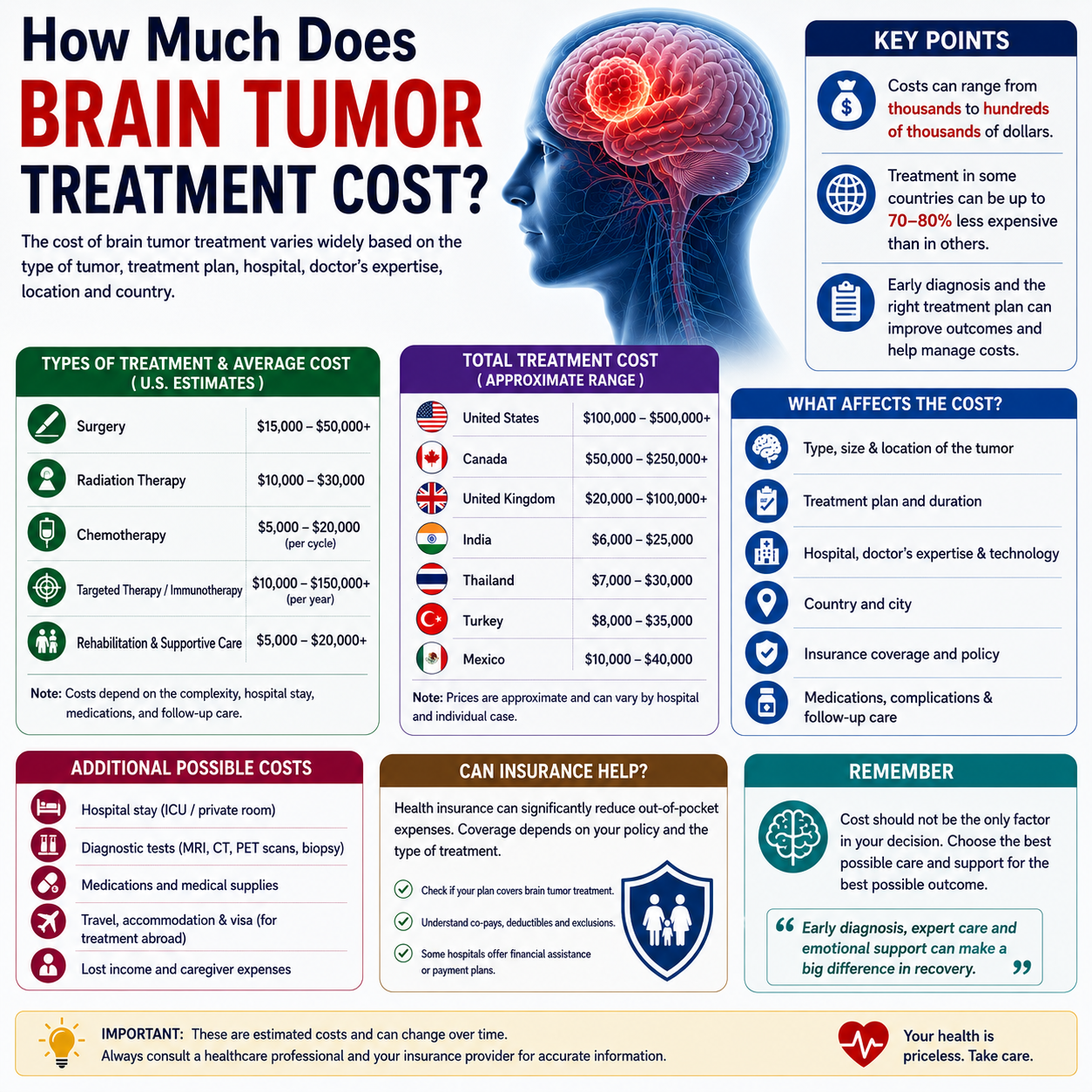
Brain tumor treatment is expensive for several specific reasons. Surgery requires highly specialized neurosurgeons, advanced equipment, and prolonged operating room time. Radiation therapy — particularly stereotactic radiosurgery systems like Gamma Knife — represents significant capital investment for hospitals. Many chemotherapy drugs used for brain tumors are expensive brand-name medications. Diagnostic imaging — multiple MRI scans throughout treatment — adds substantial cost. And brain tumor treatment typically extends over months, involving many separate medical encounters.
The total cost for aggressive brain tumor treatment — surgery, radiation, chemotherapy, imaging, and associated care — often reaches hundreds of thousands of dollars over the full treatment course.
Surgery Costs
Brain tumor surgery is one of the most expensive surgical procedures performed. In the United States, costs vary significantly based on tumor complexity, surgical duration, hospital type, and geographic location.
A standard craniotomy for brain tumor removal — including surgeon fees, anesthesiologist fees, operating room costs, hospital stay, and post-operative monitoring — typically ranges from $50,000 to $150,000 without insurance. Complex surgeries involving longer procedures, specialized technology like intraoperative MRI, or intensive care complications can substantially exceed this range.
The hospital stay following brain tumor surgery adds several thousand dollars per day. Most patients stay between three and ten days. ICU time — typically required for at least the first day or two — costs significantly more than standard ward accommodation.
Stereotactic needle biopsy — when performed instead of open surgery — costs considerably less, typically $15,000 to $35,000 without insurance, reflecting the shorter procedure time and briefer hospital stay.
Radiation Therapy Costs
A standard six-week course of external beam radiation therapy — typically 30 sessions — costs between $30,000 and $60,000 without insurance in the United States. This covers the planning sessions, simulation appointment, and each daily treatment session.
Stereotactic radiosurgery — Gamma Knife, CyberKnife, or similar systems — is delivered in fewer sessions but costs more per session. A single Gamma Knife treatment typically costs $8,000 to $15,000 per session without insurance. Treatment involving multiple brain metastases in one session or requiring multiple sessions multiplies this cost.
Proton therapy — available at specialized centers — carries higher costs than standard photon radiation, typically $30,000 to $120,000 for a full course depending on number of sessions and facility.
Chemotherapy Costs
Chemotherapy costs vary dramatically based on the specific drug used.
Temozolomide — the most commonly prescribed brain tumor chemotherapy — is available in generic form and costs significantly less than it did when patent-protected. A monthly cycle of generic temozolomide typically costs $300 to $1,500 depending on dose and pharmacy, making it among the more affordable oncology drugs when generic versions are used.
Bevacizumab — used for recurrent glioblastoma — is considerably more expensive. Each IV infusion costs approximately $4,000 to $7,000 without insurance, delivered every two weeks. A year of bevacizumab treatment can exceed $100,000 in drug costs alone.
PCV chemotherapy — procarbazine, lomustine, and vincristine — involves three separate drugs over multiple cycles. Total drug costs for a complete course typically range from $5,000 to $20,000 depending on generic availability and dosing.
Diagnostic Imaging Costs
Brain tumor patients undergo extensive MRI imaging — at diagnosis, before and after surgery, during treatment, and for monitoring during follow-up. Each brain MRI with contrast costs between $1,500 and $5,000 without insurance depending on facility and geographic location.
A typical glioblastoma patient might undergo 8 to 12 MRI scans in the first year of treatment and monitoring. This alone can represent $15,000 to $50,000 in imaging costs before insurance adjustments.
CT scans — less expensive than MRI at approximately $500 to $3,000 each — are also used in specific circumstances. PET scans for tumor evaluation cost $3,000 to $6,000 without insurance.
Physician and Specialist Fees
Brain tumor care involves multiple specialists — neurosurgeon, neuro-oncologist, radiation oncologist, neurologist, and supporting specialists like neuropsychologists, physiatrists, and palliative care physicians. Each specialist bills separately from the facility where services are performed.
Neurosurgeon fees for craniotomy typically range from $5,000 to $25,000, separate from hospital facility fees. Neuro-oncology consultation visits cost $300 to $600 each — with many visits required over months of treatment. Radiation oncology fees for a full treatment course can reach $15,000 to $30,000 in physician fees beyond facility costs.
Supportive Care and Medications
Beyond active treatment costs, brain tumor patients incur significant ongoing medication costs. Corticosteroids like dexamethasone are relatively inexpensive. Anti-seizure medications like levetiracetam are available generically at modest cost. Anti-nausea medications, proton pump inhibitors, and other supportive medications add several hundred dollars monthly.
Rehabilitation services — physical therapy, occupational therapy, speech therapy — typically cost $150 to $400 per session without insurance. Many brain tumor patients require weeks to months of these services.
Home health nursing, medical equipment like wheelchairs or shower chairs, and home modifications for patients with neurological deficits add further costs that vary widely by individual circumstance.
Total Treatment Cost Estimates
Putting these components together, total first-year treatment costs for different brain tumor scenarios — before insurance — look approximately like this.
A Grade 1 meningioma treated with surveillance only carries imaging costs of perhaps $3,000 to $10,000 in the first year. A meningioma treated with Gamma Knife carries $15,000 to $30,000 in treatment costs plus imaging. A meningioma treated with surgical removal adds $60,000 to $120,000 in surgical and hospital costs to imaging and follow-up expenses.
Glioblastoma treatment — surgery, concurrent chemoradiation, and adjuvant chemotherapy — routinely costs $300,000 to $600,000 in the first year before insurance adjustments. Including all physician fees, imaging, supportive care, and medications, total first-year costs frequently exceed $500,000 for aggressive initial treatment.
These figures represent charges before insurance negotiated rates and coverage. Most patients with insurance pay a fraction of these amounts through their coverage — but the out-of-pocket fractions on bills this large can still be substantial.
What Patients Actually Pay With Insurance
With insurance, actual patient costs depend on the specific plan’s deductible, out-of-pocket maximum, coinsurance rates, and network status of providers.
Most Americans with insurance face annual out-of-pocket maximums — the most a patient pays in a given year before insurance covers 100% of remaining costs. For 2026, out-of-pocket maximums for marketplace plans cannot exceed approximately $9,450 for individual coverage or $18,900 for family coverage under ACA regulations.
For catastrophic treatment costs like glioblastoma treatment, most patients with insurance reach their out-of-pocket maximum early in the treatment year. Once reached, insurance covers remaining covered expenses at 100% for that year. The following year’s deductible resets — so ongoing treatment in year two begins the cost-sharing cycle again.
Out-of-network care creates substantially higher costs. Brain tumor patients should verify that their neurosurgeon, hospital, radiation facility, and oncologist are all in-network before proceeding with treatment at any facility — to the extent this is possible given urgency constraints.
Indirect and Non-Medical Costs
The financial impact of brain tumor treatment extends beyond direct medical costs — and these indirect costs are often underestimated.
Lost income — from the patient’s inability to work during treatment and recovery — represents potentially the largest financial impact for many families. Glioblastoma treatment typically prevents full-time work for six months to a year or longer. Disability insurance, if in place before diagnosis, provides partial income replacement. Short-term and long-term disability policies differ significantly in their waiting periods and benefit amounts.
Caregiver costs — either lost income from a family member who reduces work to provide care, or paid caregiver costs if family resources are unavailable — add significantly to the financial burden. Professional home caregivers cost $25 to $40 per hour in most US markets.
Transportation to daily radiation appointments over six weeks, parking at medical facilities, and travel to specialized treatment centers represent real cumulative costs — sometimes thousands of dollars over a treatment course.
Childcare, home maintenance, and other tasks the patient previously performed but cannot during treatment require either family help or paid alternatives.
Questions to Ask the Hospital Financial Counselor
Every hospital providing brain tumor treatment has financial counselors — staff whose job includes helping patients understand and manage treatment costs. Request a meeting with a financial counselor early in the treatment process — ideally before treatment begins when possible.
- What is the estimated total cost of the recommended treatment?
- What will my insurance cover, and what is my estimated out-of-pocket responsibility?
- Does this hospital have financial assistance programs I may qualify for?
- Can treatment costs be structured on a payment plan?
- Are there generic medication alternatives to the prescribed drugs?
- Which providers involved in my care are in-network for my insurance?
- Does the hospital have a charity care policy if my income is limited?
A Final Word
My colleague and her husband got through the first year of treatment financially. It required careful management — she worked with the hospital’s financial counselor, applied for pharmaceutical assistance programs, contacted the National Brain Tumor Society’s financial resources team, and filed for short-term disability for her husband.
Their actual out-of-pocket costs — with good insurance and careful navigation — were far lower than the terrifying numbers she’d tried to calculate that night at the kitchen table. The system is complicated and the costs are genuinely high. But resources exist that many patients never access simply because nobody tells them to look.
The next two articles in this series cover insurance coverage in detail and financial assistance programs available to brain tumor patients. Read them alongside this one — they contain the practical tools that make the numbers in this article manageable.
For financial assistance resources, visit the
National Brain Tumor Society Financial Resources page or the
American Cancer Society Financial Help resource.
Disclaimer: This article provides general cost information for educational purposes only. Actual costs vary significantly based on location, facility, insurance coverage, and individual treatment plans. Consult your hospital’s financial counselor and insurance provider for costs specific to your situation.