What Causes Brain Tumors? Risk Factors Explained
It was: “Why did this happen to him?”
He was 47. He exercised regularly. He didn’t smoke. He ate reasonably well. There was no cancer in his immediate family. Nothing in his life seemed to explain why a tumor had grown inside his brain.
That question — why — is the one almost every brain tumor patient and family asks. And the honest answer is complicated, often frustrating, and sometimes impossible to resolve with certainty.
This article explains what science actually knows about brain tumor causes — what increases risk, what doesn’t, and why so many cases remain unexplained.
The Uncomfortable Truth About Brain Tumor Causes
Most brain tumors have no clearly identifiable cause. This is not a failure of medicine. It reflects the genuine complexity of how cancers develop.
Tumor development involves multiple genetic changes accumulating in a single cell over time. These changes alter how cells grow, divide, and die. When enough changes stack up, normal regulatory systems break down — and a tumor begins.
What triggers these genetic changes? Sometimes known factors — radiation exposure, specific inherited mutations. Often, the changes happen through normal cellular processes: DNA replication errors, random mutations, exposure to factors whose effects accumulate gradually over decades.
Identifying a single cause for any individual brain tumor is rarely possible. What science can identify is factors that increase the probability of these genetic changes occurring.
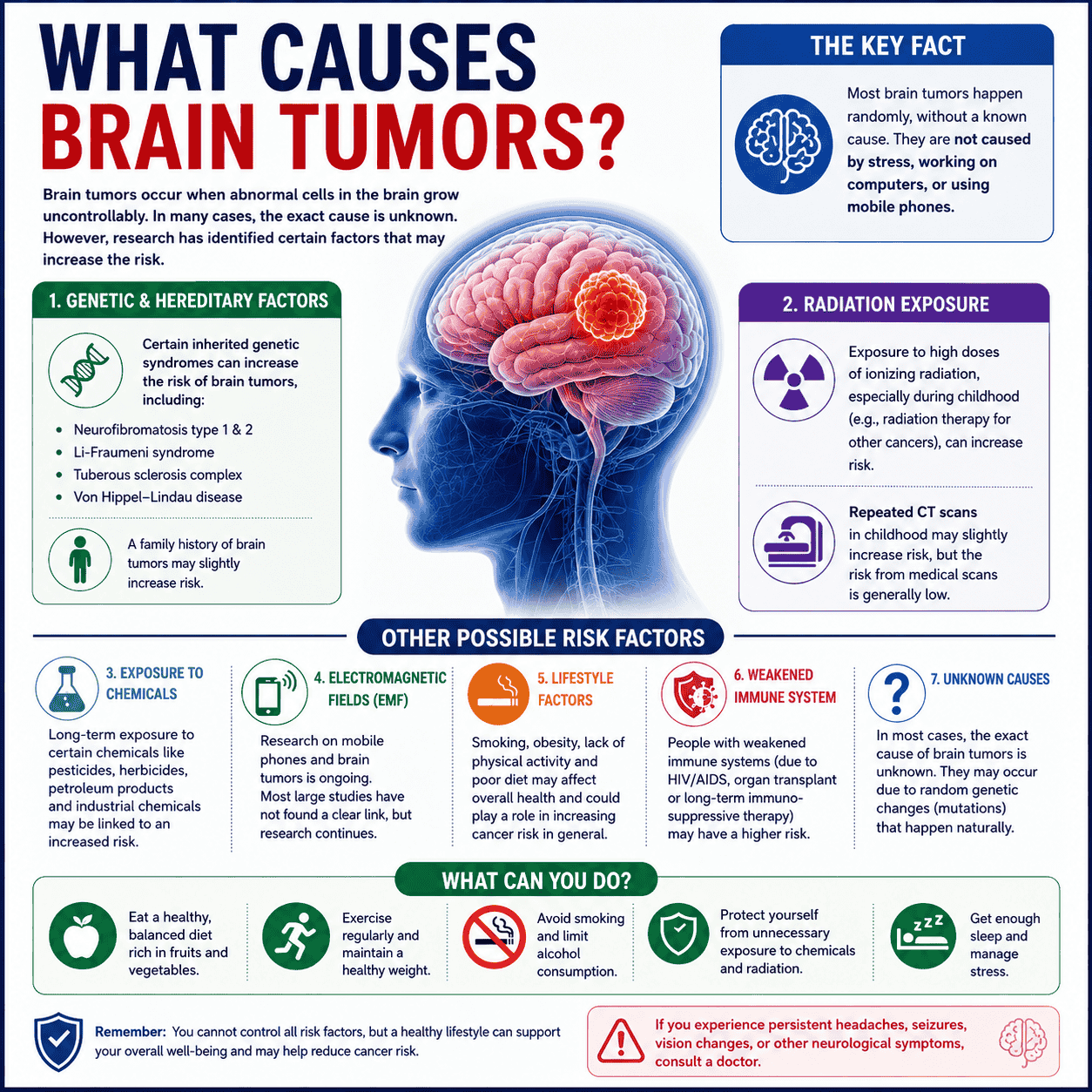
Established Risk Factor 1: Ionizing Radiation Exposure
Ionizing radiation is the strongest known environmental risk factor for brain tumors. The evidence is clear and consistent across multiple studies spanning decades.
The most significant documented risk comes from therapeutic radiation — radiation delivered to the head as treatment for other conditions. Children treated with cranial radiation for leukemia or other childhood cancers face substantially elevated brain tumor risk years to decades later. People who received scalp irradiation for conditions like ringworm in earlier eras — a historical practice now abandoned — show increased meningioma rates.
The risk from therapeutic radiation is real and documented. Modern radiation therapy uses far more precise techniques than historical approaches, limiting dose to surrounding tissue. But any therapeutic radiation to the head carries some long-term risk that oncologists factor into treatment decisions.
Nuclear accident survivors — including those exposed at Hiroshima and Nagasaki — show elevated brain tumor rates consistent with radiation-induced DNA damage.
Established Risk Factor 2: Rare Inherited Genetic Syndromes
Certain inherited genetic syndromes significantly increase brain tumor risk. These conditions account for a small but clearly defined subset of all brain tumors.
Neurofibromatosis type 1 (NF1) predisposes to optic gliomas, astrocytomas, and other brain tumors. The NF1 gene normally suppresses tumor growth. When inherited mutations disable this gene, cell growth regulation breaks down.
Neurofibromatosis type 2 (NF2) strongly predisposes to meningiomas and acoustic neuromas. People with NF2 often develop multiple tumors simultaneously, sometimes beginning in young adulthood.
Li-Fraumeni syndrome involves inherited mutations in the TP53 tumor suppressor gene. Affected individuals face elevated risk of multiple cancer types including gliomas, often at younger ages than typical.
Von Hippel-Lindau disease causes hemangioblastomas in the brain and spinal cord, alongside tumors in other organs.
Turcot syndrome combines colorectal polyp conditions with brain tumor predisposition — particularly glioblastoma and medulloblastoma.
Gorlin syndrome (basal cell nevus syndrome) predisposes to medulloblastoma — a tumor common in the cerebellum of affected children.
Collectively, these inherited syndromes explain approximately 5% of all brain tumors. The vast majority of brain tumors occur without any identifiable inherited predisposition.
Risk Factor 3: Age
Brain tumor risk increases with age for most tumor types. The overall incidence rate rises steadily from middle age onward. Adults over 65 face the highest rates of malignant brain tumors.
This age-related increase reflects the accumulation of genetic damage over time. More years of living means more opportunities for cells to acquire the multiple mutations needed for tumor development.
The relationship isn’t universal across all tumor types. Medulloblastoma occurs most commonly in children. Certain gliomas have incidence peaks in younger adults. But for the most common and aggressive brain tumors — including glioblastoma — age is a consistent and significant risk factor.
Risk Factor 4: Sex and Hormonal Factors
Men develop malignant brain tumors at slightly higher rates than women. Glioblastoma, in particular, shows a consistent male predominance across most populations studied.
Women develop meningiomas — typically benign tumors — at roughly twice the rate of men. This female predominance links to hormonal factors. Many meningiomas carry receptors for estrogen and progesterone. The tumors sometimes grow faster during pregnancy when hormone levels peak. Postmenopausal hormone replacement therapy use associates modestly with increased meningioma risk in some studies.
The exact mechanisms linking sex hormones to meningioma development remain under active investigation.
Risk Factor 5: Immune System Conditions
People with severely compromised immune systems face higher rates of certain brain tumors — particularly primary central nervous system lymphoma. HIV infection, organ transplantation requiring immunosuppressive medications, and certain autoimmune conditions requiring immune suppression all carry elevated lymphoma risk.
The connection between immune function and tumor surveillance is well established. The immune system normally identifies and destroys abnormal cells. When immune function is severely impaired, this surveillance breaks down — allowing certain tumor types to develop that a healthy immune system might have eliminated.
Factors That Research Has NOT Confirmed as Causes
Public understanding of brain tumor causes contains significant misinformation. Several factors widely believed to cause brain tumors lack credible scientific support.
Cell Phones and Wireless Technology
The relationship between mobile phone use and brain tumor risk has been studied intensively for over two decades. Cell phones emit non-ionizing radiofrequency radiation — fundamentally different from the ionizing radiation that demonstrably causes brain tumors.
Multiple large studies — including the INTERPHONE study involving over 13,000 participants and the Million Women Study — found no statistically significant association between mobile phone use and glioma or meningioma risk. Brain tumor incidence rates have not increased in parallel with the explosive growth in mobile phone use over the past 30 years.
A detailed explanation of this topic appears in a separate article on this site. The summary is that current evidence does not establish mobile phones as a brain tumor cause.
Power Lines and Electromagnetic Fields
Residential proximity to power lines has been studied extensively. Overall, evidence doesn’t support power lines as a brain tumor risk factor in adults. Some studies suggested possible associations in children for leukemia, not brain tumors — and even those associations remain contested.
Head Injury
Head injuries do not cause brain tumors. This is a persistent misconception. Head trauma may lead to brain imaging that discovers a pre-existing tumor — creating an apparent association — but the trauma itself doesn’t cause the tumor to develop.
Stress
Psychological stress does not directly cause brain tumors. Chronic stress affects immune function and inflammatory processes in ways that may theoretically influence cancer development, but no direct causal link between stress and brain tumor development has been established. This topic receives fuller treatment in a dedicated article on this site.
Artificial Sweeteners
Aspartame and other artificial sweeteners were widely suspected of causing brain tumors following some animal studies in the 1990s. Subsequent large human studies found no association between aspartame consumption and brain tumor risk. Regulatory agencies worldwide have reviewed this evidence and found artificial sweeteners safe at consumption levels people actually encounter.
What Happens at the Cellular Level
Understanding tumor development at the cellular level helps explain why single causes are rarely identifiable.
Every cell division involves copying approximately three billion DNA base pairs. Errors occur during this copying process. Most errors are caught and repaired by cellular proofreading mechanisms. Some escape repair. Most escaped errors are harmless. Occasionally, an error affects a gene that regulates cell growth or death.
A single such error rarely causes cancer. Multiple errors — typically involving several specific genes — must accumulate in the same cell lineage. This accumulation takes time. It’s why cancer risk increases with age. And it’s why most brain tumors develop without a single identifiable triggering cause.
The mutations found in brain tumors — IDH mutations, EGFR amplification, TP53 mutations, PTEN loss — represent specific genetic changes that disrupt tumor suppressor functions or activate growth signals. Understanding these molecular drivers now shapes diagnosis and treatment decisions in ways that weren’t possible even fifteen years ago.
Why “I Did Everything Right” Is Still No Guarantee
My colleague’s husband — the 47-year-old who exercised, didn’t smoke, and had no family history — fits a pattern that appears repeatedly in brain tumor medicine.
Many glioblastoma patients are relatively young, apparently healthy, and without any of the established risk factors. Their tumors developed through the accumulation of cellular errors that no lifestyle choice could have reliably prevented.
This is genuinely difficult to accept. The desire to find a reason — something that could have been avoided — is deeply human. But for the majority of brain tumors, no such reason exists. The tumor wasn’t caused by something the patient did or failed to do.
Understanding this doesn’t answer “why.” But it can relieve the burden of misplaced guilt that so many patients and families carry unnecessarily.
What You Can Actually Reduce Your Risk With
Given that most brain tumor risk comes from factors outside individual control — age, random genetic errors, rare inherited syndromes — what can people actually do?
Avoid unnecessary medical radiation to the head. Pediatric imaging guidelines recommend the lowest radiation dose necessary for diagnosis. Adults should discuss radiation risk with doctors when head imaging is proposed.
If a family history suggests an inherited syndrome — multiple family members with brain tumors or other syndrome-associated cancers at young ages — genetic counseling can identify whether testing is appropriate and what surveillance might be warranted.
Maintain general health practices that support immune function and reduce overall cancer risk. While none of these prevents brain tumors specifically, they support overall wellbeing and may reduce risk across multiple cancer types.
A Final Word
My colleague never found a definitive answer to why her husband’s tumor developed. His neurosurgeon was honest: for most glioblastomas, no identifiable cause exists.
That answer didn’t satisfy her. It rarely satisfies anyone. But it was the truthful one — and truth, even uncomfortable truth, is more useful than false certainty.
Brain tumors happen to people who did nothing wrong. Understanding the factors that genuinely influence risk — and separating them from factors that don’t — is the most honest thing medicine can offer in answer to the question “why.”
For more information about brain tumor risk factors, visit the
American Cancer Society Brain Tumor Risk Factors page or the
Mayo Clinic Brain Tumor Causes resource.
Disclaimer: This article serves educational and informational purposes only. It does not constitute medical advice. Please consult a qualified healthcare professional for guidance specific to any individual situation.