Brain Tumor Insurance Coverage: What You Need to Know
One was with the neurosurgeon — discussing surgery timing, treatment approach, and what to expect in the coming months.
The other was with the hospital’s billing department — because her father had just turned 64, was between jobs, and his insurance situation was complicated.
That second conversation was just as urgent as the first. A brain tumor diagnosis without clear insurance coverage is a medical emergency wrapped inside a financial emergency. Understanding what insurance actually covers — and what to do when it doesn’t — is information every brain tumor family needs as early as possible.
What Health Insurance Typically Covers for Brain Tumors
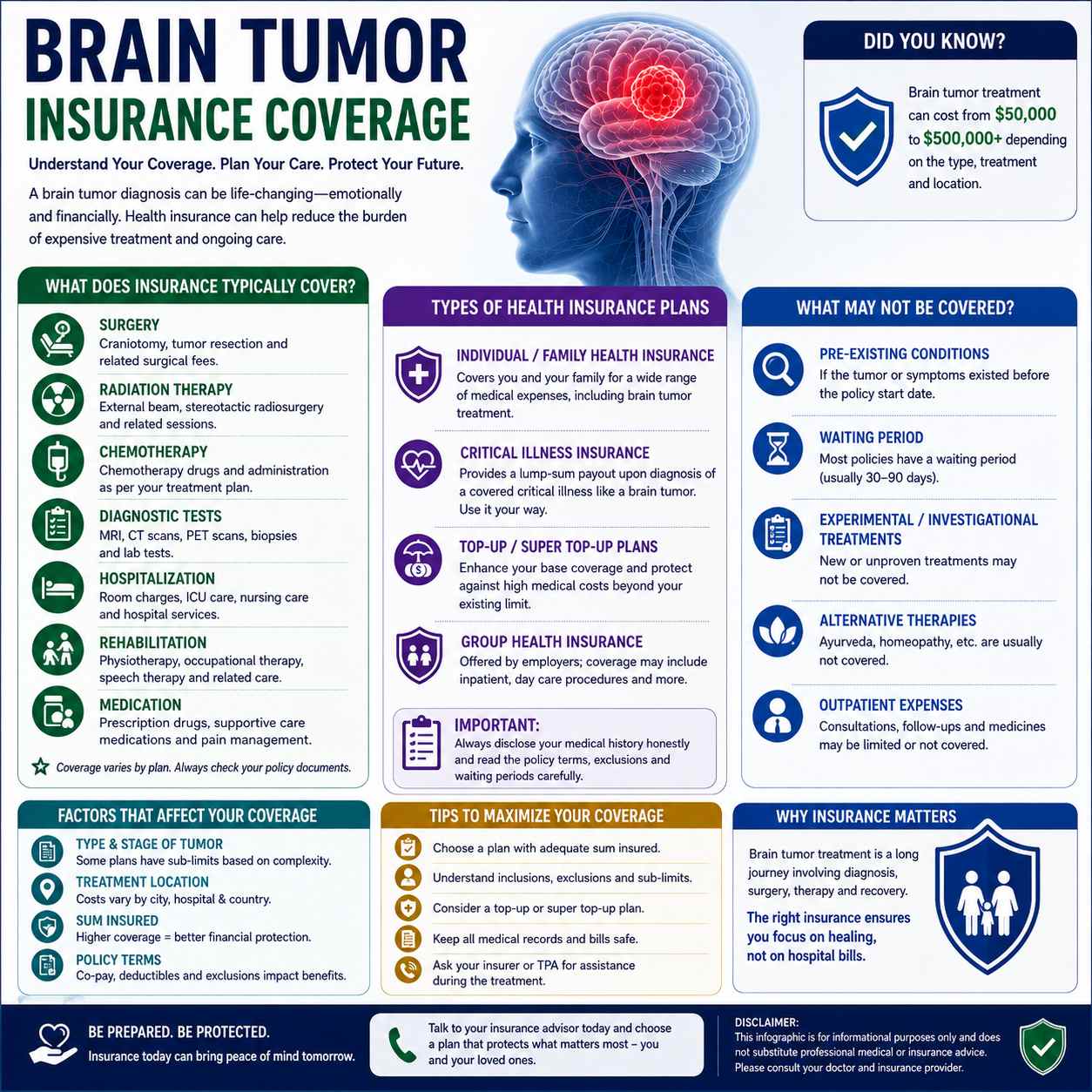
Standard health insurance in the United States — both employer-sponsored plans and Affordable Care Act marketplace plans — generally covers the core treatments for brain tumors as medically necessary care.
Coverage typically includes brain tumor surgery and hospitalization, standard external beam radiation therapy, chemotherapy with established drugs like temozolomide, diagnostic imaging including MRI and CT scans, pathology and laboratory testing, specialist consultations with neurosurgeons and oncologists, and medically necessary rehabilitation services.
These treatments are covered because they represent the established standard of care. Insurers generally cannot deny coverage for treatments that clinical guidelines define as medically necessary for a confirmed brain tumor diagnosis.
However, coverage doesn’t mean free. Most insurance plans require patients to meet annual deductibles before coverage kicks in, pay co-insurance — a percentage of each cost — and pay co-payments for appointments and prescriptions. These patient responsibility amounts accumulate significantly across brain tumor treatment.
Understanding Your Plan’s Key Numbers
Before treatment begins, understanding these specific numbers from your insurance plan prevents financial surprises.
Deductible is the amount you pay out of pocket before insurance begins paying. Annual deductibles for individual plans commonly range from $500 to $7,000. Family deductibles are higher. For a brain tumor diagnosis in the first month of a plan year, the full deductible applies immediately.
Out-of-pocket maximum is the most you’ll pay in a plan year before insurance covers 100% of costs. ACA plans cap this at $9,450 for individuals and $18,900 for families in 2026. Once this threshold is reached, insurance pays everything for the rest of the year. For brain tumor patients, reaching the out-of-pocket maximum often happens quickly — sometimes within the first month of treatment.
Co-insurance is the percentage split between you and insurance after the deductible is met. A common split is 80/20 — insurance pays 80%, you pay 20% — until the out-of-pocket maximum is reached.
Network status determines how your costs are calculated. In-network providers have negotiated rates with your insurer. Out-of-network providers charge higher rates, and insurance pays a smaller percentage — sometimes nothing at all. Confirming that your neurosurgeon, hospital, radiation oncologist, and neuro-oncologist are all in-network before treatment begins prevents unexpected out-of-network bills.
Treatments That Face Coverage Challenges
While standard treatments are generally covered, several approaches commonly face insurance pushback.
Proton Therapy
Proton therapy costs significantly more than conventional radiation. Insurers frequently require documentation that proton therapy provides clinical benefit over standard radiation for the specific tumor type before approving coverage. For certain pediatric brain tumors and tumors near critical structures, coverage is more commonly approved. For adult glioblastoma, approval is less consistent.
Prior authorization for proton therapy typically requires detailed documentation from the radiation oncologist explaining why proton therapy is medically necessary for this specific patient rather than standard photon radiation.
Tumor Treating Fields (TTFields)
TTFields — the Optune device used alongside chemotherapy for glioblastoma — received FDA approval in 2015 for newly diagnosed glioblastoma and in 2011 for recurrent disease. Despite FDA approval, coverage varies significantly by insurer. Some major insurers cover it; others consider it investigational.
Appeals for TTFields coverage denials have been successful when supported by documentation of FDA approval status and published clinical trial evidence showing survival benefit. The device manufacturer — Novocure — offers patient support programs that assist with insurance appeals and provides the device through rental rather than purchase.
Off-Label Drug Use
When oncologists prescribe chemotherapy drugs approved for one cancer type to treat a brain tumor — based on shared molecular characteristics — insurers sometimes deny coverage for off-label use. Approval requires documentation of clinical evidence supporting the specific use, published guidelines or compendia listing the use, and sometimes peer-to-peer review with the treating oncologist.
Immunotherapy for Brain Tumors
Checkpoint inhibitors approved for other cancers — when used for brain tumor patients, particularly those with brain metastases from responsive cancer types — face variable coverage. Coverage is most consistent when the drug is used for a cancer type for which it’s approved and brain metastases represent spread of that approved indication.
Genetic and Molecular Testing
Comprehensive molecular profiling of brain tumor tissue — now standard for treatment planning — faces variable coverage. Basic testing like IDH mutation status and MGMT methylation is generally covered. Comprehensive genomic profiling panels sometimes require prior authorization or appeals.
The Prior Authorization Process
Prior authorization is the insurer’s review process that must be completed before expensive treatments begin. Understanding this process prevents treatment delays.
The treating physician’s office submits a prior authorization request with clinical documentation supporting medical necessity. The insurer reviews — typically within 3 to 15 business days for standard requests, or 24 to 72 hours for urgent requests. Approval allows treatment to proceed with coverage. Denial triggers the appeals process.
For urgent brain tumor treatments — particularly surgery when neurological deterioration is occurring — most insurers have expedited review processes. Emergency surgery can proceed before authorization is complete when delay would cause serious harm. Document the medical urgency clearly when requesting expedited review.
Always get prior authorization decisions in writing. Verbal approvals that aren’t documented create billing disputes later.
When Insurance Denies Coverage — The Appeals Process
Coverage denials happen regularly for brain tumor treatments. A denial is not the final answer. The appeals process exists specifically to challenge denials — and it succeeds more often than most patients expect.
Step 1: Understand the Denial Reason
The denial letter must specify why coverage was denied. Common reasons include medical necessity not established, treatment considered investigational or experimental, prior authorization not obtained, out-of-network provider, or benefit exclusion.
The denial reason determines the appeal strategy. A denial for “investigational” treatment requires evidence that the treatment is established and FDA-approved. A denial for “medical necessity” requires clinical documentation supporting why this specific treatment is needed for this patient.
Step 2: File an Internal Appeal
Submit a formal written appeal to the insurer within the deadline specified in the denial letter — typically 30 to 180 days. Include a letter from the treating physician detailing medical necessity, relevant clinical trial evidence, published treatment guidelines, and any peer-reviewed literature supporting the treatment.
Request that the appeal be reviewed by a physician with relevant specialty expertise — not a general reviewer. This is your right under insurance regulations.
Step 3: Request an Expedited Appeal
When treatment delay would cause serious harm, request an expedited internal appeal. Insurers must respond within 72 hours to expedited appeals. Medical documentation of urgency from the treating physician supports this request.
Step 4: External Independent Review
If the internal appeal is denied, request external independent review. An independent organization — not affiliated with the insurer — reviews the denial. External reviewers overturn insurer denials in approximately 40% of cases in published studies. This process is free to patients and legally binding on the insurer.
Step 5: State Insurance Commissioner Complaint
Filing a complaint with your state’s insurance commissioner creates a regulatory record and sometimes resolves disputes that appeals processes haven’t. Insurance commissioners investigate bad-faith denial practices.
Step 6: Patient Advocacy Organizations
The Patient Advocate Foundation provides free case management services that help brain tumor patients navigate insurance disputes. They’ve resolved thousands of coverage denials for cancer patients and understand the specific documentation and arguments that succeed with different insurers.
Medicare Coverage for Brain Tumors
Medicare — federal insurance for adults 65 and older and qualifying disabled individuals — covers brain tumor treatment through its various parts.
Medicare Part A covers inpatient hospitalization for surgery and inpatient rehabilitation. Part B covers outpatient physician services, radiation therapy, chemotherapy administered in an outpatient setting, and durable medical equipment. Part D covers oral chemotherapy drugs including temozolomide — though coverage, formulary placement, and co-pays vary by specific Part D plan.
Medicare Supplement (Medigap) plans cover co-insurance, deductibles, and other gaps in standard Medicare coverage. Patients with significant treatment costs benefit substantially from Medigap coverage that limits out-of-pocket exposure.
Medicare Advantage plans — private insurance plans approved to provide Medicare benefits — have varying coverage rules and network restrictions that differ from original Medicare. Review specific plan coverage before committing to an Advantage plan for brain tumor treatment.
Social Security Disability Insurance recipients become eligible for Medicare after 24 months of disability payments. Brain tumor patients under 65 who qualify for SSDI gain Medicare coverage after this waiting period — an important consideration for longer-term treatment planning.
Medicaid Coverage
Medicaid provides health coverage for qualifying low-income individuals and families. Coverage and eligibility vary by state under ACA expansion provisions.
States that expanded Medicaid cover adults earning up to 138% of the federal poverty level. Medicaid covers brain tumor treatment — surgery, radiation, chemotherapy, and ongoing care — for eligible recipients. Co-pays are minimal or absent.
Income and asset requirements mean that some brain tumor patients don’t qualify for Medicaid at diagnosis but may qualify if treatment costs deplete savings and income drops. Hospital financial counselors and social workers assist with Medicaid applications and can identify whether eligibility exists or might be established.
COBRA Coverage After Job Loss
Brain tumor patients who lose employer-sponsored insurance because they can no longer work — or lose a job — may continue previous coverage through COBRA for up to 18 months.
COBRA allows continuation of exactly the same insurance coverage but at full premium cost — typically $500 to $1,500 monthly for individual coverage and $1,500 to $3,000 for family coverage. These costs are significant but maintain continuity of care with existing providers during a period when changing insurance would disrupt treatment.
Election of COBRA must happen within 60 days of losing coverage. Missing this window eliminates the COBRA option.
Special Enrollment Periods
A brain tumor diagnosis — and the resulting job loss or changes in coverage — typically qualifies as a special enrollment period for marketplace insurance plans. Patients who lose employer coverage, experience Medicaid eligibility changes, or have other qualifying life events can enroll in marketplace coverage outside the standard open enrollment window.
Marketplace plans purchased through healthcare.gov receive premium subsidies based on income. For brain tumor patients whose income drops during treatment, subsidized marketplace coverage can provide comprehensive coverage at manageable premium costs.
What to Do Immediately After Diagnosis
Taking these specific financial and insurance steps in the days immediately after diagnosis prevents larger problems later.
Request a financial counseling appointment at the treating cancer center before treatment begins. Most major centers employ financial counselors specifically for this purpose. This appointment identifies coverage issues, assistance programs, and out-of-pocket cost projections before bills arrive.
Confirm insurance coverage for all treating providers before each appointment. Ask specifically whether each physician, facility, and service is in-network. Get confirmation in writing or document the call with date, time, and representative name.
Request itemized bills for all services. Billing errors are common in complex medical care. Patients who request and review itemized bills — not just summary bills — frequently identify charges for services not received or duplicate billing.
Ask about financial hardship programs at the treating institution. Most hospitals have charity care programs for patients facing financial difficulty. These programs reduce or eliminate bills for qualifying patients regardless of insurance status.
Contact pharmaceutical manufacturers for patient assistance with expensive drugs before the first prescription is filled. Applying early — before the first prescription — ensures assistance is in place from the start.
A Final Word
My friend’s father’s insurance situation eventually resolved — more smoothly than those first hours suggested it would. A financial counselor spent time with the family, identified a Special Enrollment Period for marketplace coverage, confirmed subsidy eligibility based on his income situation, and connected him with a pharmaceutical assistance program for his chemotherapy.
The total out-of-pocket costs were still real and still required adjustment. But the unlimited financial fear of those first hours — when everything seemed unresolvable — gave way to a specific, manageable plan.
That transition from overwhelming fear to specific plan is available to every brain tumor family. It starts with getting financial and insurance support involved early — as early as the first week after diagnosis — rather than waiting until bills arrive and options have narrowed.
Insurance is complicated. Brain tumor treatment is expensive. Neither of those facts has to translate into financial devastation for families who know where to turn and when.
For more information about insurance coverage and financial resources, visit the
National Brain Tumor Society Financial and Insurance Resources page or the
Patient Advocate Foundation website for free case management support.
Disclaimer: This article serves educational and informational purposes only. Insurance coverage rules, benefit amounts, and eligibility requirements vary significantly by plan, insurer, state, and individual circumstances. Please consult your insurance provider, a certified insurance counselor, and your cancer center’s financial counseling department for guidance specific to your situation.