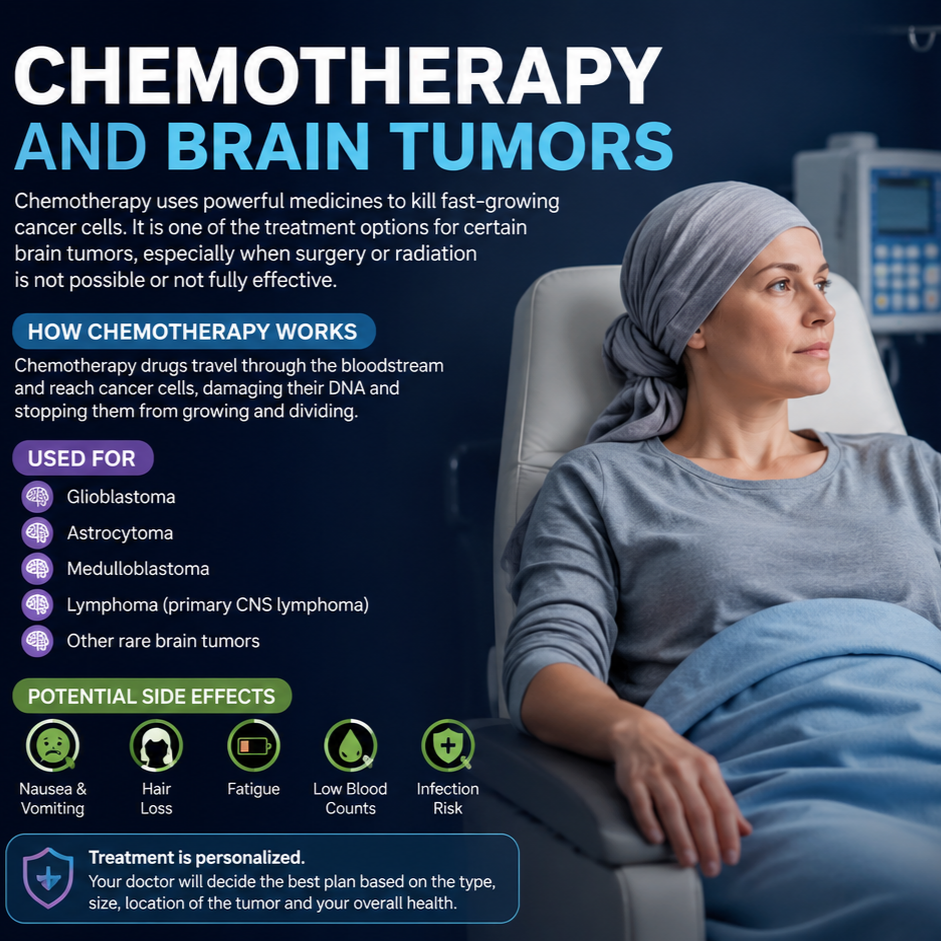
Chemotherapy and Brain Tumors: How It Works and What to Expect
“Will I lose all my hair?”
It’s the question most people ask first. And the honest answer — for the most common brain tumor chemotherapy drug — is no. The drug most frequently used for brain tumors doesn’t cause the dramatic hair loss associated with breast or lung cancer chemotherapy.
That surprised him. And it opened up a longer conversation about what brain tumor chemotherapy actually looks like — how different it is from what most people picture, and why the brain’s unique biology makes this treatment both challenging and fascinating.
This article covers everything patients and families need to know about chemotherapy for brain tumors — which drugs exist, why some work better than others, what side effects are real, and what the experience of treatment actually feels like.
Why Brain Tumor Chemotherapy Is Different
Chemotherapy for brain tumors faces a challenge that most other cancer treatments don’t: the blood-brain barrier.
This protective barrier surrounds the brain’s blood vessels. It filters what enters and exits the brain with extraordinary selectivity. Most chemotherapy drugs that kill cancer effectively elsewhere in the body cannot cross this barrier in meaningful concentrations.
Only certain drugs have the molecular characteristics needed to penetrate the blood-brain barrier. Brain tumor chemotherapy is limited to this relatively small group. This explains why treatment options differ significantly from chemotherapy used for other cancer types.
Temozolomide — The Most Important Drug
Temozolomide is the cornerstone chemotherapy drug for glioblastoma and certain other high-grade gliomas. It’s an oral medication — patients take it as a capsule, not through an IV.
The drug crosses the blood-brain barrier effectively. Inside tumor cells, it damages DNA by attaching chemical groups to specific DNA bases. This damage interferes with cell division. Tumor cells cannot replicate properly and eventually die.
How Doctors Use Temozolomide
The standard treatment approach combines temozolomide with radiation therapy simultaneously. Patients take temozolomide daily throughout the six-week radiation course — this is called concurrent chemoradiation.
After radiation finishes, patients rest for four weeks. Then they begin adjuvant temozolomide — a monthly cycling schedule. Each cycle involves taking the drug daily for five consecutive days, followed by 23 days without it. This schedule allows normal cells to recover. Most patients complete six cycles over approximately six months.
Why MGMT Methylation Matters
Temozolomide’s effectiveness depends heavily on one molecular characteristic: MGMT methylation status.
MGMT is a DNA repair enzyme. When the MGMT gene is methylated — chemically silenced — tumor cells cannot produce this repair enzyme. They cannot fix the DNA damage that temozolomide causes. The drug works significantly better.
When MGMT is unmethylated — active — tumor cells repair temozolomide damage efficiently. The drug has much less impact.
Doctors test MGMT methylation status on every glioblastoma biopsy. Patients with methylated MGMT respond better to temozolomide and tend to live longer overall. Those with unmethylated MGMT increasingly receive additional treatments alongside or instead of standard temozolomide.
Side Effects of Temozolomide
Temozolomide causes less dramatic side effects than many chemotherapy drugs. Hair loss is minimal or absent for most patients. The main side effects include nausea — usually mild and manageable with anti-nausea medication taken before each dose. Fatigue builds gradually during the concurrent radiation phase. Constipation affects some patients and responds well to dietary adjustments and mild laxatives.
The most medically significant side effect is bone marrow suppression. Temozolomide reduces production of blood cells — particularly white blood cells and platelets. Regular blood tests throughout treatment monitor these levels. Significant drops require dose adjustments or treatment delays.
A serious but uncommon complication called Pneumocystis pneumonia (PCP) — a fungal lung infection — can develop in immunosuppressed patients during temozolomide treatment. Preventive antibiotics protect against this throughout the concurrent treatment phase.
Lomustine (CCNU)
Lomustine is an oral chemotherapy drug used for various brain tumor types. It belongs to a class called alkylating agents, working similarly to temozolomide by damaging tumor cell DNA.
Doctors prescribe lomustine as a single oral dose taken once every six weeks. This schedule reflects how long the drug affects bone marrow — blood counts need six weeks to recover before the next dose.
Lomustine treats recurrent glioblastoma and certain Grade 3 gliomas. It also forms part of the PCV combination used for oligodendrogliomas.
Side effects include nausea on dosing day, significant bone marrow suppression requiring careful blood monitoring, and potential lung toxicity with prolonged use.
PCV Chemotherapy — Procarbazine, Lomustine, and Vincristine
PCV combines three chemotherapy drugs into one regimen. Oncologists use it primarily for oligodendrogliomas — a specific glioma subtype with the 1p/19q co-deletion molecular characteristic.
These tumors respond to PCV chemotherapy remarkably well. Clinical trials show that combining PCV with radiation significantly extends survival compared to radiation alone for 1p/19q co-deleted tumors — in some studies by years rather than months.
PCV causes more significant side effects than temozolomide alone. Nausea, fatigue, and bone marrow suppression are common. Vincristine causes peripheral neuropathy — tingling and numbness in the hands and feet — that can persist after treatment ends.
Bevacizumab — Targeting Tumor Blood Supply
Bevacizumab is not a traditional chemotherapy drug. It’s a targeted antibody that blocks VEGF — vascular endothelial growth factor — the protein tumors use to grow new blood vessels.
Tumors need blood vessels to grow. Blocking VEGF starves the tumor of the new vascular supply it needs to expand. Bevacizumab reduces tumor size on MRI and often improves neurological symptoms significantly.
Doctors use bevacizumab for recurrent glioblastoma. It’s delivered intravenously every two weeks. The drug controls tumors effectively in many patients, but hasn’t consistently extended overall survival in large clinical trials.
Side effects differ from traditional chemotherapy. Bevacizumab causes high blood pressure, fatigue, and impaired wound healing. It carries a risk of blood clots — both arterial clots causing stroke and venous clots — that requires monitoring.
Gliadel Wafers — Chemotherapy Delivered Directly
Gliadel wafers represent an approach to bypassing the blood-brain barrier entirely. Instead of delivering chemotherapy through the bloodstream, surgeons place these biodegradable wafers directly into the surgical cavity after tumor removal.
Each wafer contains carmustine — a chemotherapy agent. The wafers dissolve slowly over several weeks, releasing carmustine directly where the tumor was. Local drug concentrations far exceed what systemic chemotherapy could achieve while minimizing drug exposure to the rest of the body.
Gliadel wafers provide a modest survival benefit in selected patients with newly diagnosed and recurrent high-grade gliomas. They’re not appropriate for every surgical case — wafer placement increases infection risk and can complicate wound healing.
Chemotherapy for Brain Metastases
When cancer spreads to the brain from another location — lung, breast, kidney, colon, or skin — treatment targets both the original cancer and the brain disease simultaneously.
Chemotherapy for brain metastases depends on the primary cancer type and whether the drugs used to treat that cancer can cross the blood-brain barrier. Certain drugs used for HER2-positive breast cancer — including capecitabine and lapatinib — show activity against breast cancer brain metastases. EGFR inhibitors and ALK inhibitors used for lung cancer reach brain metastases in meaningful concentrations.
The treatment of brain metastases increasingly integrates systemic chemotherapy, targeted therapy, immunotherapy, and radiation based on the molecular characteristics of the primary tumor.
What Chemotherapy Treatment Feels Like Day to Day
My neighbor’s daily experience during concurrent chemoradiation was manageable in ways he hadn’t anticipated.
He took his temozolomide capsule each evening — timing it away from meals reduced nausea. An anti-nausea tablet taken an hour before helped significantly. He drove himself to radiation appointments each morning. He worked part-time through weeks one to four. Fatigue became more noticeable in weeks five and six, requiring more rest.
The monthly adjuvant cycles felt different. Five days of capsules each month, with the remaining 23 days feeling relatively normal. His appetite fluctuated on dosing days. Blood tests every three weeks monitored his counts. The overall experience was intermittent difficulty punctuated by periods of feeling largely like himself.
Every patient’s experience differs. Tumor location, radiation field, overall health, and individual drug metabolism all affect how treatment feels. But the common experience — particularly with temozolomide — is often less dramatically difficult than patients fear beforehand.
Questions to Ask Your Neuro-Oncologist About Chemotherapy
- Which chemotherapy drug will I receive, and why is this drug right for my tumor type?
- What is my MGMT methylation status, and how does it affect my treatment plan?
- Will I take chemotherapy orally or intravenously?
- What specific side effects should I prepare for?
- How often will blood tests happen, and what counts would require changing the plan?
- Are there clinical trials testing newer drugs I might be eligible for?
- What happens if this chemotherapy stops working?
A Final Word
My neighbor completed his chemotherapy. He told me afterward that the hardest part wasn’t the nausea or the fatigue — it was the uncertainty. Not knowing whether the treatment was working. Not knowing what the next scan would show.
Understanding the treatment itself — what the drugs actually do, why specific drugs are chosen, what the experience feels like — gave him something to hold onto during that uncertainty. It made him a participant in his own care rather than just a recipient of it.
That participation matters. It doesn’t change the biology. But it changes how people experience the process of confronting it.
For more information about chemotherapy for brain tumors, visit the
American Cancer Society Chemotherapy page or the
Mayo Clinic Chemotherapy guide.
Disclaimer: This article serves educational and informational purposes only. It does not constitute medical advice. Please consult a qualified neuro-oncologist for chemotherapy guidance specific to any individual diagnosis.