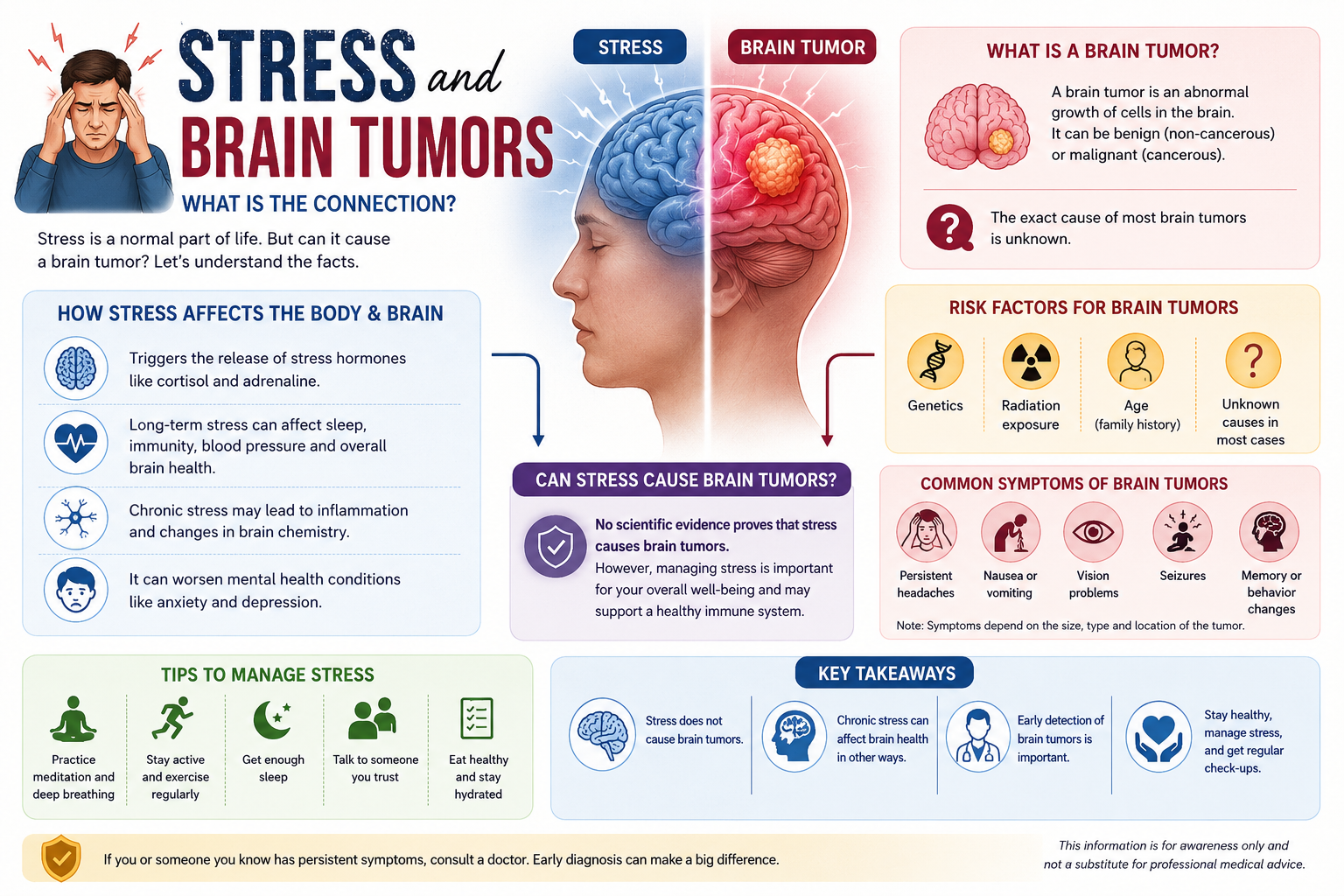
Stress and Brain Tumors: Is There a Real Connection?
She had spent fifteen years managing a demanding team, working long hours, rarely switching off. When the diagnosis came, the narrative felt obvious to her. The stress had caused the tumor. She had brought this on herself.
That conclusion was emotionally compelling and scientifically unfounded. But unpacking why requires understanding what stress actually does to the body — and where the evidence genuinely stands on stress and brain cancer.
What Chronic Stress Does to the Body
Chronic stress is genuinely harmful to health. This is well-established. The mechanisms are real and measurable.
The body responds to stress through two main pathways. The sympathetic nervous system triggers the classic fight-or-flight response — releasing adrenaline, raising heart rate and blood pressure, redirecting blood to muscles. The hypothalamic-pituitary-adrenal (HPA) axis releases cortisol — the primary stress hormone — which mobilizes energy, suppresses inflammation acutely, and affects multiple organ systems.
Chronic activation of these systems — sustained over months and years — produces measurable biological effects. Cortisol chronically suppresses immune function, including natural killer cell activity — one of the immune system’s mechanisms for eliminating abnormal cells. Chronic stress promotes systemic inflammation. It shortens telomeres — the protective caps on chromosome ends that shorten with each cell division, a marker of cellular aging. It disrupts sleep, which itself affects immune function and cellular repair.
All of these mechanisms are plausibly relevant to cancer development in general. The question is whether they specifically elevate brain tumor risk.
What the Research Actually Shows
The evidence for a direct link between psychological stress and brain tumor development is limited and inconsistent. This is the honest assessment of the current literature.
Several large prospective studies have examined stress-related factors — work stress, major life events, anxiety diagnoses, depression — and subsequent cancer risk. These studies generally show modest associations between chronic stress and certain cancer types. The associations are stronger for immune-related cancers — lymphomas, for example — where immune surveillance is a primary defense mechanism.
For primary brain tumors specifically — gliomas and meningiomas — the evidence is much weaker. Some studies find no significant association between psychological stress measures and brain tumor risk. Others find modest associations that don’t replicate consistently across populations and methodologies.
A major methodological challenge affects this entire research area: stress is extremely difficult to measure objectively. Self-reported stress levels are subjective and affected by personality, perception, and cultural factors. Different studies define and measure stress differently, making comparison difficult.
Why the “Stress Causes Cancer” Narrative Is Oversimplified
The idea that stress causes cancer — including brain tumors — is widespread in popular culture. It contains a grain of biological plausibility surrounded by significant oversimplification.
Biological mechanisms through which chronic stress might promote cancer exist. They’re real. But “mechanism exists” is not the same as “mechanism is sufficient to cause cancer.”
The immune system’s impairment under chronic stress is real but doesn’t mean cancer inevitably follows. The immune system has significant redundancy. Most people under significant chronic stress never develop cancer. Many people with excellent stress management develop cancer anyway.
Cancer — including brain tumors — requires multiple genetic changes accumulating over time. The random nature of these changes means that reducing stress, while supporting health in multiple ways, doesn’t provide reliable protection against the cellular events that eventually produce a tumor.
The Dangerous Consequence of the Stress-Causes-Cancer Narrative
The belief that stress causes brain tumors creates a specific harm that deserves direct attention: self-blame.
When patients connect their brain tumor to their stressful life — as my neighbor did immediately — they experience guilt and responsibility for an illness that developed through biological processes largely outside their control. This self-blame compounds an already devastating situation with unnecessary psychological burden.
It’s not only unsupported by evidence. It’s actively harmful.
Most glioblastoma patients are otherwise healthy adults with no identifiable risk factors beyond age and the random accumulation of genetic mutations. Attributing their tumor to their stress level or lifestyle choices does them a profound disservice.
Understanding that brain tumors happen to people who did everything right — who managed their stress well, exercised, ate well, and lived thoughtfully — is not nihilistic. It’s accurate. And accuracy is kinder than false causal narratives that leave patients feeling responsible for their own illness.
Stress After Diagnosis — A Different and Important Topic
While stress probably doesn’t cause brain tumors, stress after diagnosis is a critical concern that deserves full attention.
A brain tumor diagnosis is one of the most acutely stressful events a person can experience. The months of treatment that follow involve sustained, profound psychological stress alongside the physical demands of surgery, radiation, and chemotherapy.
This post-diagnosis stress affects quality of life, treatment tolerance, sleep, immune function, and psychological wellbeing in ways that are clinically significant. Managing it effectively matters enormously — not because stress management will change the tumor’s biology, but because it affects every dimension of how patients experience their illness and treatment.
Mind-body practices — particularly mindfulness-based stress reduction — have genuine evidence for reducing anxiety, depression, and fatigue in cancer patients. Regular physical activity reduces stress hormones and improves mood through multiple mechanisms. Social support — connection with family, friends, and peer communities — is one of the most consistently documented buffers against the psychological effects of serious illness.
These interventions don’t prevent or treat the brain tumor. They support the person living with it.
What Stress Management Genuinely Offers
Reducing chronic stress is worth pursuing for multiple well-established reasons — none of which require the “stress causes brain tumors” narrative to be true.
Chronic stress damages cardiovascular health — elevating blood pressure, increasing heart disease risk. It impairs immune function in ways relevant to multiple conditions. It disrupts sleep, which affects cognitive function, mood, and metabolic health. It contributes to depression and anxiety disorders that significantly reduce quality of life. It may modestly contribute to overall cancer risk through the mechanisms described earlier.
These consequences are sufficient reason to take stress management seriously — without needing to attribute brain tumors specifically to stress.
Practical approaches include regular physical activity, consistent sleep schedules, meaningful social connection, mindfulness or meditation practice, setting appropriate boundaries at work, pursuing activities that provide genuine restoration, and seeking professional support when stress becomes unmanageable through self-directed approaches.
What My Neighbor Needed to Hear
Her tumor wasn’t caused by work stress. Her oncologist told her this directly — explaining that glioblastoma develops through genetic mutations that accumulate over decades through processes unrelated to how hard she worked or how stressed she felt.
She needed to hear that she hadn’t done this to herself. That her fifteen years of hard work didn’t produce the tumor. That the diagnosis was unfair precisely because it happened without cause — not because she brought it on through choices she could have made differently.
That understanding didn’t make her diagnosis easier. Nothing makes it easy. But it removed a layer of guilt that would have made everything harder — and replaced it with something more accurate and more bearable: the understanding that this happened to her rather than because of her.
That distinction matters more than most people realize.
A Final Word
Stress and brain tumors probably have some biological relationship — through immune effects, inflammatory pathways, and cellular aging mechanisms. The evidence doesn’t establish stress as a direct brain tumor cause. Most people under significant chronic stress never develop brain tumors. Many brain tumor patients report low stress levels before diagnosis.
Managing chronic stress matters for overall health, quality of life, and treatment tolerance. It’s worth doing for those reasons — significant reasons on their own.
But brain tumor patients don’t need to carry the additional burden of believing their illness is their fault. It isn’t.
For more information about stress and cancer, visit the
National Cancer Institute Stress and Cancer Fact Sheet or the
American Cancer Society Emotional Health resource.
Disclaimer: This article serves educational and informational purposes only. It does not constitute medical or psychological advice. Please consult qualified healthcare professionals for guidance specific to any individual situation.