Brain Tumor Headache vs Normal Headache: How to Tell the Difference
“Do you think this one is something serious?”
She’s not someone who catastrophizes generally. She’s a rational person with a demanding job and a busy life. But ever since her colleague was diagnosed with a brain tumor — whose first symptom was persistent headaches — she finds herself wondering whether each significant headache is something more than just a headache.
She’s not unusual. This question crosses the minds of millions of people. And given that headaches are one of the most common symptoms reported by brain tumor patients, the concern makes sense — even if the vast majority of headaches have nothing to do with brain tumors at all.
Understanding what specifically distinguishes a brain tumor headache from an ordinary one helps people calibrate their concern accurately — neither dismissing symptoms that deserve attention nor living in constant anxiety about headaches that are completely benign.
The Most Important Context First
The overwhelming majority of headaches — including severe, debilitating ones — are not caused by brain tumors.
Tension headaches, migraines, cluster headaches, and headaches from sinus congestion, dehydration, poor posture, eye strain, and medication overuse account for the vast majority of headaches experienced by the population. These conditions are extremely common. Brain tumors are relatively rare.
Approximately 15% of people experience migraines. Tension headaches affect even larger proportions of the population. Brain tumors — while not rare in absolute terms — affect a fraction of one percent of people each year.
Starting from this context prevents the anxiety spiral that turns every headache into potential cancer. Statistically, a headache is almost certainly not a brain tumor. Understanding which specific characteristics should prompt concern is more useful than general fear.
What Brain Tumor Headaches Feel Like
Brain tumors cause headaches through increased intracranial pressure — pressure inside the skull that rises as the tumor grows and as surrounding brain swelling develops. This mechanism produces headaches with characteristic patterns that differ from tension and migraine headaches in identifiable ways.
The Morning Pattern
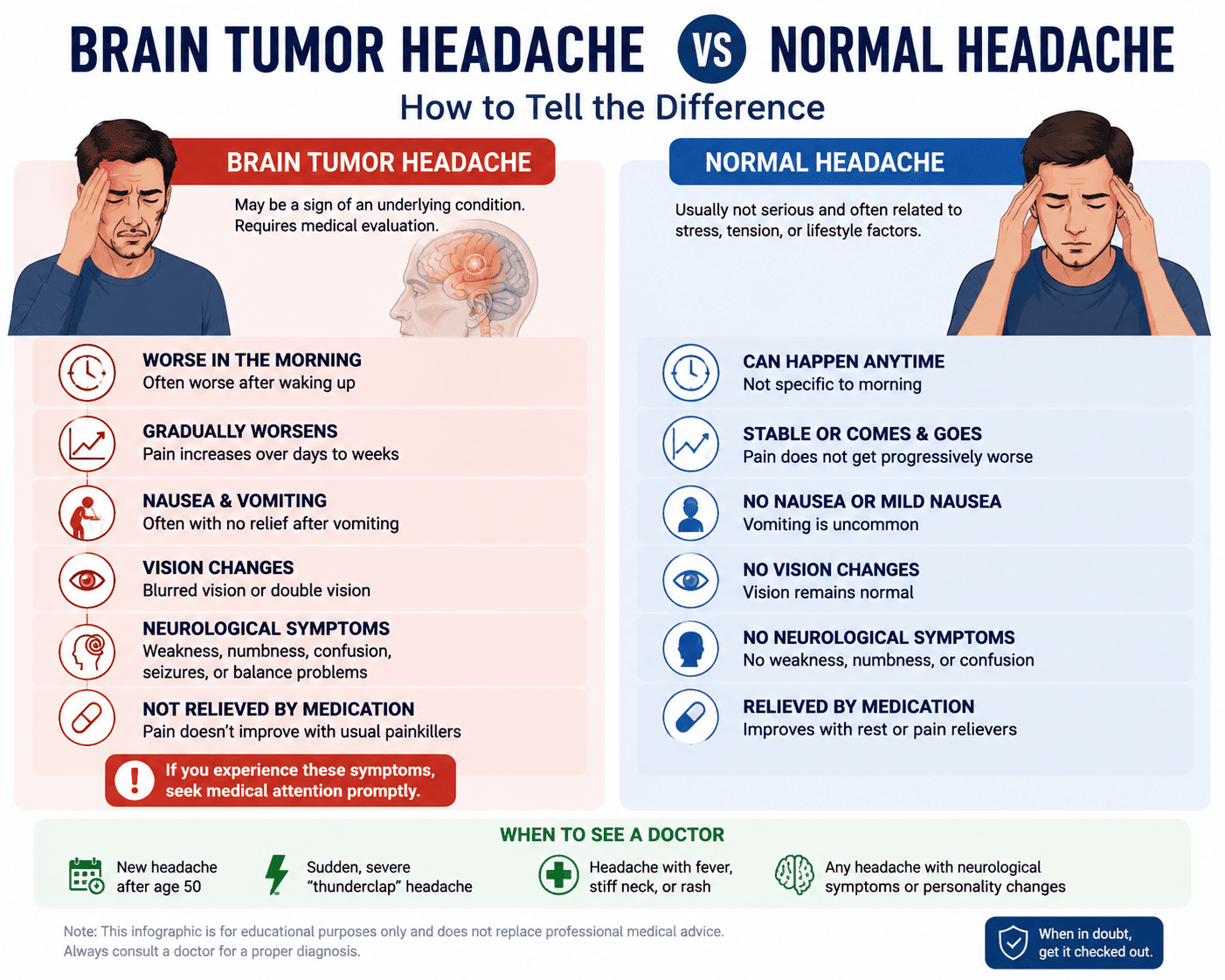
Brain tumor headaches are classically worst in the morning — immediately after waking up, often before getting out of bed.
This morning peak reflects the physiology of intracranial pressure. Lying flat overnight changes the dynamics of cerebrospinal fluid circulation. Pressure builds during horizontal sleep in a way it doesn’t during the day when the body is upright. By morning, pressure has peaked. The headache is at its worst.
As the patient gets up, moves around, and spends time upright, pressure normalizes and the headache typically improves during the morning.
This morning-dominant pattern — headache that wakes someone up or greets them immediately upon waking, then improves during the day — is characteristic of raised intracranial pressure and warrants evaluation when persistent.
Waking From Sleep
A headache that pulls someone from deep sleep in the middle of the night is a specific red flag. Normal tension headaches and migraines don’t typically wake people from sleep — though they can be present when someone wakes naturally.
A headache severe enough to interrupt sleep — particularly the 3 to 4am period of deepest sleep — and that does this repeatedly on multiple nights, deserves medical evaluation.
Position-Dependent Worsening
Brain tumor headaches worsen with activities that temporarily increase intracranial pressure. Bending forward, coughing, sneezing, straining during bowel movements, and vigorous exercise can all significantly intensify the headache.
This position-dependent component isn’t diagnostic on its own — cough headaches exist as a separate primary headache disorder — but combined with other features, it contributes to the overall picture.
Progressive Worsening Over Time
This is probably the most important single characteristic: a brain tumor headache gets progressively worse over weeks to months. It doesn’t come and go. It doesn’t have good periods and bad periods in the way migraines do. The baseline pain level, frequency, or severity trends steadily upward over time.
A headache that someone has been getting for years — even a bad one — that follows its usual pattern isn’t concerning in the way a new headache that has been gradually worsening over the past three months is. The trend matters more than the severity at any single moment.
Poor Response to Standard Pain Relief
Ordinary headaches — even severe migraines — typically respond at least partially to appropriate treatment: rest in a dark room, hydration, over-the-counter analgesics, migraine-specific medications. Response may be incomplete, but there’s some improvement.
Brain tumor headaches from raised intracranial pressure don’t respond well to standard pain relief. The underlying pressure is still there. Ibuprofen or paracetamol addresses pain signaling without touching the cause. The headache returns fully once medication wears off, and the pattern persists daily.
Accompanied by Other Neurological Symptoms
This is a crucial differentiating factor. A headache appearing alongside neurological symptoms — vision changes, weakness on one side of the body, speech difficulties, new-onset seizures, significant cognitive changes — carries a very different implication than a headache in isolation.
Migraines can cause visual disturbances — the classic aura — but migraine aura has specific characteristics (zigzag patterns, expanding scotoma) and resolves within 20 to 60 minutes. Persistent vision changes, particularly affecting one eye or one visual field, that don’t resolve are a red flag.
New weakness in an arm or leg appearing alongside headaches requires urgent evaluation. Speech becoming noticeably harder combined with headaches warrants prompt neurological assessment.
What Normal Headaches Look Like
Understanding what brain tumor headaches look like is most useful when contrasted with the patterns of common, benign headaches.
Tension Headaches
Tension headaches are the most common type — affecting the majority of adults at some point. They feel like pressure or tightness around the head, often described as a band or vice squeezing the skull. They’re typically bilateral — affecting both sides of the head. They don’t typically worsen with physical activity. They don’t cause nausea or sensitivity to light in the way migraines do.
Tension headaches worsen with stress, poor posture, eye strain, dehydration, and fatigue. They respond reasonably well to over-the-counter analgesics, rest, and stress reduction. They improve when the triggering factors resolve.
Migraines
Migraine is a neurological condition — not simply a bad headache. Classic migraines involve moderate to severe unilateral (one-sided) throbbing pain, nausea and sometimes vomiting, and significant sensitivity to light and sound. Many people have prodrome symptoms — mood changes, yawning, food cravings — in the hours before pain begins. Some experience aura — visual, sensory, or speech disturbances — in the 20 to 60 minutes before headache onset.
Migraine typically lasts 4 to 72 hours untreated. It responds to migraine-specific medications — triptans, gepants — and is often managed with preventive treatment in frequent sufferers.
The key distinguishing features from brain tumor headaches: migraines follow a recognizable pattern for each individual, often for years. They don’t progressively worsen over months in the way brain tumor headaches do. They respond to appropriate treatment. They don’t cause persistent neurological changes between attacks.
Cluster Headaches
Cluster headaches are severe, strictly one-sided headaches centered around one eye — often with tearing, redness of the eye, and nasal congestion on the affected side. They come in clusters — occurring daily or multiple times daily for weeks or months, then disappearing entirely for months or years.
Their pattern is so characteristic — same-sided, same location, associated with autonomic features — that they’re generally distinguishable from brain tumor headaches by their clinical presentation. But new-onset cluster-like headaches without prior history warrant neurological evaluation to confirm the diagnosis.
The Red Flag Symptoms — When to Seek Evaluation Promptly
Certain headache features warrant prompt medical evaluation — not as a reason for panic, but as signals that deserve investigation rather than watchful waiting.
Thunderclap headache: A headache reaching maximum intensity within seconds to a minute — often described as the worst headache of the patient’s life. This pattern requires emergency evaluation to rule out subarachnoid hemorrhage — a bleeding emergency — before brain tumor or other causes are considered.
New headache after age 50: Developing a new headache pattern in later life warrants evaluation, since new headaches at this age are more likely to have secondary causes than new headaches in younger adults.
Headache progressively worsening over weeks to months: As described above — the trend of increasing severity or frequency over time is a red flag regardless of current intensity.
Headache with fever, neck stiffness, or rash: These suggest possible meningitis — a medical emergency requiring immediate evaluation.
Headache after head trauma: Particularly if worsening rather than improving after injury.
Headache with neurological symptoms: Any combination of headache with new weakness, vision changes, speech difficulties, coordination problems, or altered consciousness.
Headache worse in the morning and on lying down: As described — this pattern particularly warrants evaluation.
Headache in someone with known cancer: New headaches in cancer patients require evaluation to rule out brain metastases.
What to Tell Your Doctor
When describing headaches to a doctor, specific information dramatically improves the evaluation’s usefulness.
Describe when the headaches started. Explain whether they’re new or a change from a longstanding pattern. Note the time of day they’re worst. Describe whether they wake you from sleep. Note whether specific actions — bending, coughing, lying down — make them worse. Describe any associated symptoms — nausea, vision changes, weakness, speech difficulties. Note what makes them better or worse. Describe how they’ve changed over time — are they the same as when they started, or progressively different?
Keeping a headache diary for two to four weeks before an appointment provides this information systematically and helps both you and your doctor identify patterns that individual episodes might obscure.
What Happens During Medical Evaluation
When you describe concerning headache features to a doctor, a neurological examination assesses brain function. If specific red flags are present, brain imaging follows — typically MRI with contrast for the most complete picture of brain tissue, or CT scan if rapid assessment is needed.
Normal brain imaging provides genuine reassurance. An MRI that shows no structural abnormality makes brain tumor far less likely as the cause of headaches. Most people who undergo MRI for headache evaluation find that their imaging is normal — confirming that their headaches have a benign cause.
A Final Word
My sister’s headaches are migraines. She’s had them since her twenties. They follow her recognizable pattern — one-sided, with nausea and light sensitivity, lasting a day or two, responding to her usual medication. They haven’t changed in character. They don’t wake her from sleep. They don’t worsen over months.
Understanding the specific differences between what she experiences and what brain tumor headaches look like has helped her hold the two questions separately: “Is this migraine?” and “Could this be something else?” The answer to the first is almost always yes. The answer to the second depends on whether what she’s experiencing matches the patterns described above.
That calibration — knowing what specifically warrants concern rather than experiencing generalized anxiety about every headache — is what this article aims to provide.
Most headaches are not brain tumors. Some are. Knowing which features to take seriously makes the difference between appropriate vigilance and unnecessary fear.
For more information about headache evaluation, visit the
Mayo Clinic Headache: When to See a Doctor guide or the
American Cancer Society Brain Tumor Signs and Symptoms page.
Disclaimer: This article serves educational and informational purposes only. It does not constitute medical advice or diagnosis. If you are experiencing concerning headache symptoms, please consult a qualified healthcare professional promptly.