Mobile Phones and Brain Tumors: What the Research Actually Shows
Someone hears about a brain tumor diagnosis — a friend’s parent, a colleague, a celebrity — and the first thing they say is: “It was probably from the phone, wasn’t it?”
The assumption is so widespread it feels like established fact. Phones emit radiation. Radiation causes cancer. Therefore phones cause brain cancer.
The logic sounds reasonable. The conclusion, however, is not what decades of scientific research actually supports. And given how central mobile phones are to daily life — and how much anxiety this topic generates — the real evidence deserves a clear, honest examination.
The Basic Physics — Why This Fear Makes Intuitive Sense
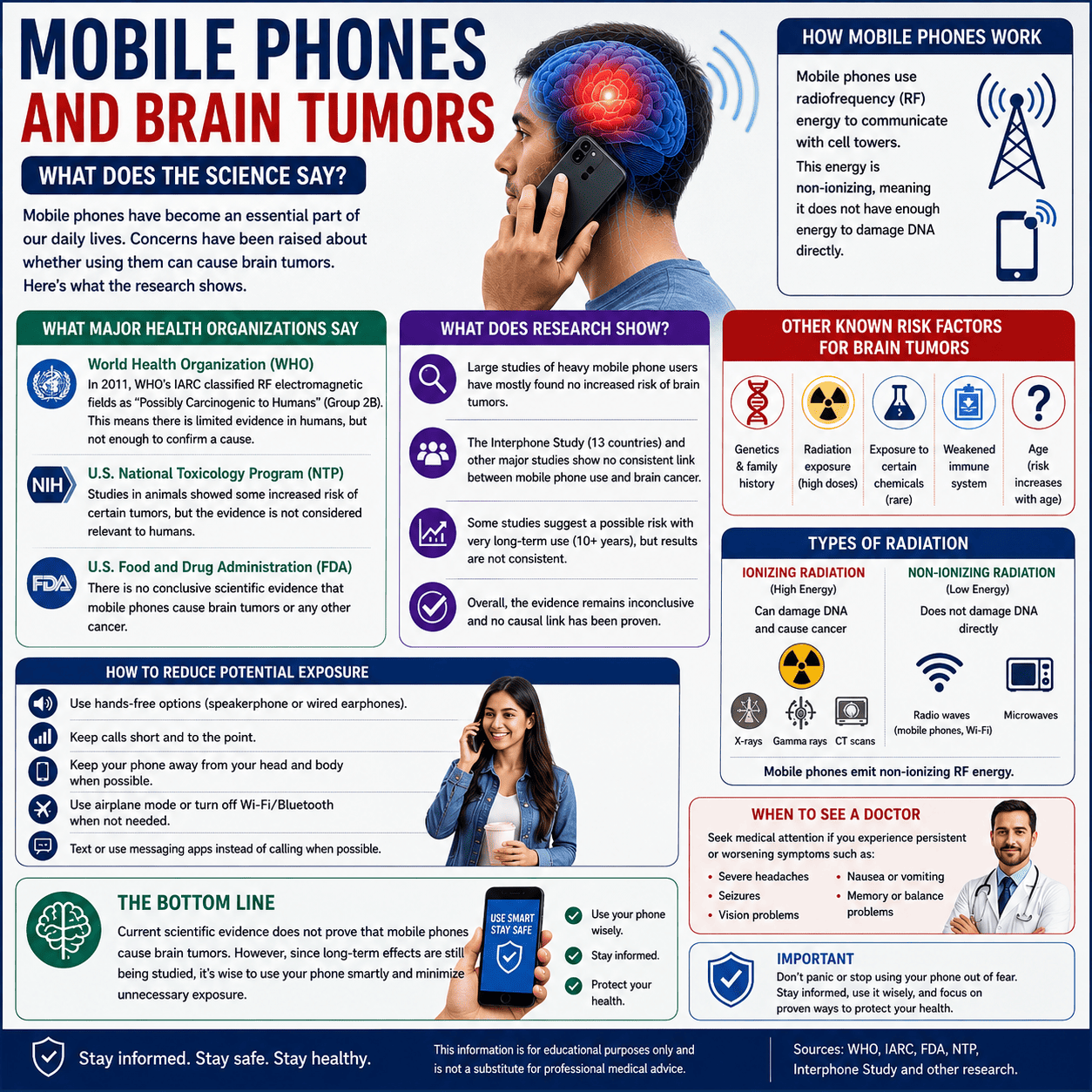
Mobile phones emit radiofrequency electromagnetic radiation — RF-EMR. Radiation is associated with cancer in people’s minds because ionizing radiation — the kind from X-rays, nuclear fallout, and gamma rays — genuinely causes DNA damage and cancer at sufficient doses.
This is where the comparison breaks down completely.
Ionizing radiation carries enough energy per photon to break chemical bonds and damage DNA directly. This is the mechanism by which radiation causes cancer.
Radiofrequency radiation from mobile phones is non-ionizing. Individual photons carry far too little energy to break chemical bonds or damage DNA directly. The energy from phone RF radiation converts to heat in tissue — the same mechanism that makes microwave ovens work. At the exposure levels from phone use, this heating effect is minimal — far below levels that cause any measurable biological harm.
The fundamental mechanism by which ionizing radiation causes cancer simply doesn’t apply to the type of radiation mobile phones emit.
What the Large Studies Actually Found
Mobile phones and brain tumors have been studied more extensively than almost any other suspected environmental carcinogen in modern history. Billions of dollars and decades of research have gone into answering this question. The results are remarkably consistent.
The INTERPHONE Study
INTERPHONE was the largest case-control study of mobile phone use and brain tumor risk ever conducted. It enrolled over 13,000 participants across 13 countries and ran for a decade. Researchers compared mobile phone use between people diagnosed with glioma or meningioma and matched controls without tumors.
The overall finding showed no increased risk of glioma or meningioma associated with mobile phone use. The study noted a possible association in the highest usage group — the top 10% of users — but the researchers concluded that this finding likely reflected biases in how people retrospectively recalled their phone use rather than a true biological effect.
The Cohort Studies
Cohort studies track large populations over time rather than relying on recalled information. The Danish cohort study followed over 420,000 mobile phone subscribers for up to 21 years. It found no increased risk of brain tumors in mobile phone users compared to non-users.
The Million Women Study in the UK found no association between mobile phone use and brain tumor incidence across over 790,000 women followed for seven years.
Population-Level Incidence Data
This is arguably the most compelling evidence available. Mobile phone use increased from near-zero in the early 1990s to nearly universal adoption over two decades. If phones caused brain tumors meaningfully, brain tumor incidence rates should have risen in parallel with this explosive growth in usage.
They haven’t. Brain tumor incidence rates have remained essentially stable — with slight increases attributable to improved detection through better imaging availability, not actual new tumors developing. This population-level stability is inconsistent with mobile phones being a significant brain tumor cause.
The Rat Studies — Why They Created Confusion
In 2016 and 2018, the US National Toxicology Program published studies showing increased rates of certain tumors in male rats exposed to high-frequency RF radiation for two years.
These studies received enormous media attention and revived public concern. They deserve honest assessment.
The radiation levels used in these studies were significantly higher than what humans experience from normal phone use — some exposures exceeded the maximum allowed exposure for humans by substantial margins. The effect appeared only in male rats, not female rats or mice. The exposed male rats also lived longer than control animals — which actually complicates the interpretation of the findings significantly.
The International Commission on Non-Ionizing Radiation Protection, the World Health Organization, and most national regulatory agencies reviewed these studies and concluded they don’t change the overall assessment of mobile phone safety for humans.
What the WHO Currently Says
The World Health Organization classifies radiofrequency electromagnetic fields as “possibly carcinogenic to humans” — Group 2B. This classification sounds alarming until you understand what it actually means.
Group 2B is the lowest carcinogen classification. It means there is limited evidence of carcinogenicity in humans and less than sufficient evidence in animals. The same category includes coffee (since reclassified as not carcinogenic), pickled vegetables, aloe vera extract, and talc-based body powder.
This classification doesn’t mean phones probably cause cancer. It means the evidence doesn’t completely rule out a possible association — which is different from demonstrating that one exists.
The WHO has been conducting a formal health risk assessment of RF fields. Their guidance continues to state that current evidence doesn’t confirm health risks from mobile phone use at levels within international guidelines.
The 5G Question
The rollout of 5G technology generated a new wave of brain tumor concern — and a significant amount of misinformation.
5G uses higher frequency millimeter waves alongside lower frequency bands similar to previous generations. Millimeter waves are non-ionizing and have even less tissue penetration than the lower frequency waves used in 4G and 3G. They are absorbed in the outer layers of the skin and don’t penetrate to brain tissue at all.
No credible scientific evidence links 5G exposure to brain tumors or any other cancer. The mechanisms proposed by 5G concern advocates are inconsistent with established physics and biology.
Why the Fear Persists Despite the Evidence
Several factors maintain public concern despite the weight of evidence.
The intuitive logic feels compelling — radiation is dangerous, phones emit radiation, therefore phones are dangerous. This chain of reasoning feels solid even though the crucial middle link is factually wrong.
Anecdotal associations are powerful. When someone who used a phone heavily develops a brain tumor, the association feels causal. Human brains are wired to find patterns, particularly when emotional stakes are high.
Media coverage has consistently overweighted alarming findings and underweighted reassuring ones. A study suggesting possible risk generates far more coverage than a larger study finding no risk — even when the reassuring study is higher quality.
Finally, industry-funded research creates legitimate concern about conflicts of interest that makes some people distrust reassuring findings regardless of their scientific quality.
Practical Guidance for People Who Remain Concerned
The scientific consensus is reassuring. But for people who remain concerned, several simple habits reduce already-low RF exposure without significant inconvenience.
Use a hands-free headset or speakerphone. Distance reduces RF exposure significantly — holding the phone away from the head during calls eliminates nearly all cranial exposure. Text rather than call when possible. In areas with poor signal, phones emit more RF power to maintain connection — avoiding extended calls in poor signal areas reduces exposure.
These precautions have no known benefit based on current evidence. But they carry no downsides — and they may provide peace of mind for people who find the topic genuinely anxiety-provoking.
What Actually Causes the Brain Tumors People Attribute to Phones
If phones aren’t the cause, what is? For most brain tumors — particularly glioblastoma — no specific environmental cause is identified. Tumors develop through accumulated genetic errors over time. Age is the most consistent risk factor. Ionizing radiation from medical or accidental exposure is the strongest known environmental cause. Certain rare inherited genetic syndromes account for a small proportion.
For most patients, the honest answer is that their tumor developed through cellular processes that don’t reduce to a single identifiable cause — regardless of how long they used their phone.
A Final Word
My own phone use hasn’t changed based on the research I’ve reviewed for this article. The evidence doesn’t support changing it.
But I understand why people find this topic unsettling. When something is used by billions of people, pressed against the skull for hours daily, any possible health effect matters enormously. The desire for certainty is entirely reasonable.
What science can offer is this: after decades of intensive study, involving millions of participants, spanning multiple countries and methodologies, no consistent evidence demonstrates that mobile phone use causes brain tumors. The current evidence is reassuring — not because the question has been dismissed, but because it has been examined more thoroughly than almost any other environmental health question in modern history.
For more information about mobile phones and brain tumor research, visit the
American Cancer Society Cell Phones and Cancer Risk page or the
National Cancer Institute Cell Phones and Cancer Fact Sheet.
Disclaimer: This article serves educational and informational purposes only. It does not constitute medical advice. Consult a healthcare professional for guidance specific to any individual health concern.