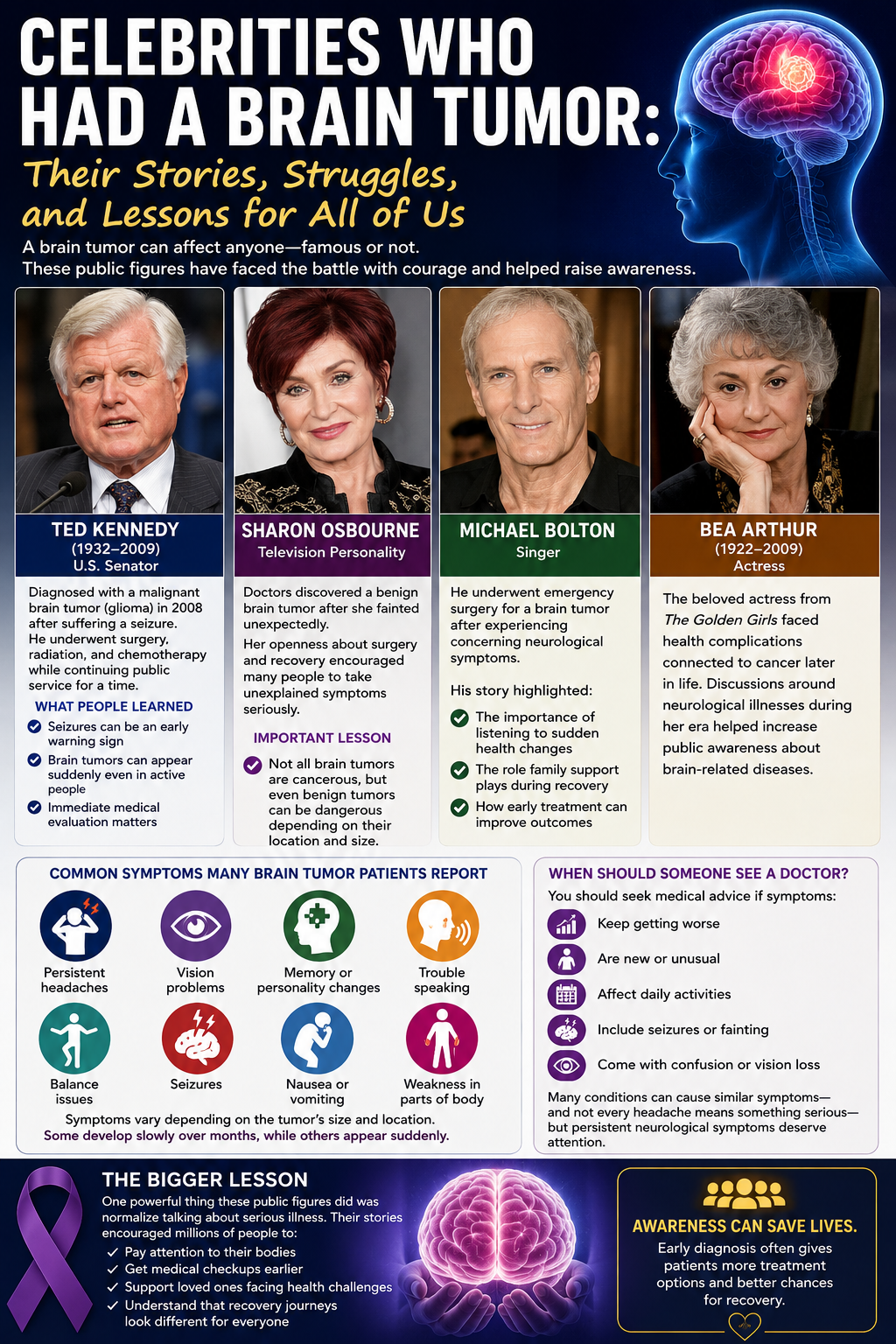
Celebrities Who Had a Brain Tumor: Their Stories, Struggles, and Lessons for All of Us
I was sitting in a waiting room at a neurology clinic a couple of years ago — not for myself, but accompanying a family member for a routine follow-up after a concerning scan.
Flipping through my phone to pass the time, I came across an old interview with a famous actress talking about her brain tumor diagnosis. I’d known her from movies my whole life. Seeing her talk about sitting in a hospital room, processing that news, made the whole thing feel suddenly very real.
Because here’s the thing about brain tumors — they don’t check your bank account, your fame, or your status before showing up. They happen to regular people and extraordinary people alike.
And sometimes, when extraordinary people share their stories, it helps the rest of us understand something we might otherwise never pay attention to.
These are those stories.
1. John McCain — The War Hero Who Fought One More Battle
John McCain survived years as a prisoner of war in Vietnam. He ran for president twice. He was one of the most recognized political figures in American history.
In July 2017, at the age of 80, he was diagnosed with glioblastoma — one of the most aggressive forms of brain cancer that exists.
Glioblastoma is brutal. The median survival after diagnosis is typically around 14 to 16 months. It grows fast, it spreads through brain tissue, and it is notoriously difficult to treat.
What’s remarkable about McCain’s story isn’t just that he fought it — it’s how he fought it. He returned to the Senate floor just days after his diagnosis to cast a critical vote. He continued showing up, continued working, continued being exactly who he had always been — right up until he couldn’t anymore.
He passed away in August 2018, fourteen months after his diagnosis.
His story brought glioblastoma into public conversation in a way it had never been before. Neurosurgeons reported increased awareness inquiries. People started asking their doctors questions they hadn’t known to ask.
That awareness matters. It genuinely saves lives.
2. Ted Kennedy — The Lion of the Senate
Barely a year before McCain’s diagnosis, the political world had faced a similar moment when Senator Ted Kennedy was diagnosed with a malignant glioma in May 2008.
Kennedy was 76 years old and had been a senator from Massachusetts for over four decades. He was one of the most powerful voices in American politics, known for his passionate advocacy for healthcare reform — which made his diagnosis carry a particular kind of painful irony.
He underwent surgery, radiation, and chemotherapy. He continued working from his home in Massachusetts and even made a memorable appearance at the Democratic National Convention that year, delivering a speech that brought the crowd to its feet.
Ted Kennedy passed away in August 2009, fifteen months after his diagnosis.
His family established the Kennedy Brain Tumor Initiative to fund research into gliomas — turning personal tragedy into a push for solutions that might help future patients.
3. Sheryl Crow — Catching It Early and Changing the Conversation
Not every celebrity brain tumor story ends in tragedy. Some end with exactly the outcome you hope for — early detection, successful treatment, and a life that continues.
Sheryl Crow, the Grammy-winning singer-songwriter behind hits like “All I Wanna Do” and “Soak Up the Sun,” announced in 2012 that she had been diagnosed with a benign brain tumor called a meningioma.
Meningiomas develop in the meninges — the membranes that surround the brain and spinal cord. The majority are benign, meaning they don’t invade surrounding tissue the way malignant tumors do. But benign doesn’t mean harmless. Depending on size and location, they can still cause serious neurological problems by pressing on brain tissue.
Crow’s tumor was discovered during an MRI she underwent after experiencing memory problems — which she had initially attributed to the natural aging process.
This is one of the most important parts of her story: she almost didn’t get that MRI.
She did. And catching it when she did meant she was able to manage it without aggressive treatment. She’s spoken publicly about monitoring it and continuing to live her life fully.
Her story became a powerful argument for taking cognitive symptoms seriously and not dismissing them as “just getting older.”
4. Mark Ruffalo — A Tumor That Changed His Perspective Forever
Before Mark Ruffalo was Bruce Banner in the Marvel universe, he had his own very real battle with a brain tumor.
In 2001, Ruffalo had a dream that he had a brain tumor. He was so unsettled by it that he went to a doctor and requested an MRI. The scan revealed an acoustic neuroma — a benign tumor on the nerve connecting his ear to his brain.
He underwent surgery to remove it. The procedure was successful, but it left him with partial facial paralysis that lasted for about a year. His hearing in one ear was also permanently affected.
Ruffalo has talked about how the experience changed his perspective on life. He was in his early thirties, relatively unknown, just starting to build his acting career. Facing a brain tumor at that stage — and coming out the other side — shaped who he became as a person and as an artist.
He’s been open about the fact that the dream that prompted him to get checked quite possibly saved his life. Which is not a medical recommendation to act on every dream — but it is a reminder that when something feels wrong, it’s always worth checking.
5. Peter Gabriel — When the Rock Star Faces Reality
Peter Gabriel, legendary musician and former Genesis frontman, revealed that he had been diagnosed with a brain tumor. His announcement was characteristically understated — he mentioned it in the context of explaining why he had been less active.
Gabriel’s situation highlighted something important: even people with the resources to access the best medical care in the world face the same uncertainty and fear that everyone else does when confronted with a brain tumor diagnosis.
Money can buy better access. It can’t buy certainty.
What These Stories Have in Common
Looking at all of these cases together, a few things stand out clearly.
Symptoms were present before diagnosis. In almost every case, there were warning signs that were either missed, dismissed, or attributed to something else. The gap between first symptom and diagnosis is often measured in months.
Early detection changes outcomes dramatically. Sheryl Crow’s benign meningioma, caught relatively early, required minimal intervention. Bob Marley’s delayed treatment had fatal consequences. The difference between these outcomes is not random.
Resources don’t eliminate fear. Every single person on this list — regardless of their fame, wealth, or access to care — faced the same fundamental terror of a brain tumor diagnosis. The human experience of confronting serious illness is universal.
Going public creates real impact. When John McCain’s glioblastoma diagnosis was announced, neurologists reported spikes in patients coming in to discuss symptoms they’d been ignoring. Celebrity stories drive awareness in ways that public health campaigns often can’t match.
Recovery is possible. Mark Ruffalo. Sheryl Crow. Lance Armstrong. These are people who faced serious neurological diagnoses and came out the other side. Brain tumor diagnosis is not automatically a death sentence — and it’s important to hold onto that truth.
The Lesson That Applies to All of Us
You don’t have to be famous for your symptoms to matter.
The headache that keeps coming back. The vision that’s been slightly off. The personality shift your family has noticed but nobody wants to bring up. The seizure that happened once and you’ve been trying to forget.
These things deserve attention. Not panic — attention.
The celebrities in this article had every resource available to them. Some still waited too long. Some caught things just in time. Some didn’t make it.
What made the difference wasn’t fame or money. It was getting checked.
That part is available to all of us.
Disclaimer: This article is for informational and educational purposes only. Medical details mentioned are based on publicly reported information. If you are experiencing neurological symptoms, please consult a qualified healthcare professional as soon as possible.