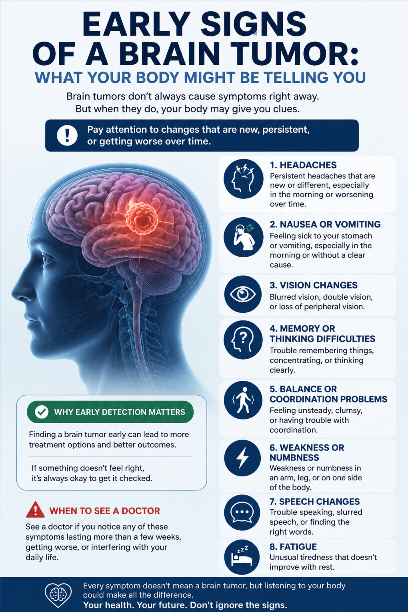
Early Signs of a Brain Tumor: What Your Body Might Be Telling You
Three years ago, my colleague Sarah started complaining about headaches.
Not the kind you get after staring at a screen too long. These were different. Persistent. Showing up at weird times. Sometimes waking her up at 3am.
She brushed it off for months. Took painkillers. Assumed it was stress from work. We all did.
Then one morning she had a seizure at her desk.
The diagnosis that followed changed everything we thought we knew about “just headaches.” She had a brain tumor — caught, thankfully, before it had progressed too far. But the warning signs had been there for almost eight months before anyone took them seriously.
That experience made me want to understand this topic properly. Not from a textbook. From reality.
This article is everything I’ve learned — written so that you actually understand it, not just memorize it.
Why Brain Tumor Symptoms Are So Easy to Miss

Here’s the frustrating truth: most early brain tumor symptoms look exactly like everyday problems.
Headache? Must be stress.
Feeling dizzy? Probably didn’t sleep enough.
Forgetting things? Welcome to modern life.
The human brain is remarkably good at compensating for problems — at least in the early stages. It reroutes. It adapts. It masks what’s happening underneath.
This is actually one of the reasons brain tumors are so dangerous. By the time symptoms become impossible to ignore, the tumor has often been growing for a while.
Knowing what to look for — and more importantly, knowing when something feels different — can genuinely save your life or someone else’s.
The Early Warning Signs You Should Never Ignore

1. Headaches That Don’t Behave Like Normal Headaches
Not all headaches are created equal. Most people have experienced tension headaches or migraines at some point. But brain tumor headaches have specific characteristics that set them apart.
They tend to be worst in the morning — right after waking up. This happens because lying flat overnight causes pressure to build inside the skull, and that pressure peaks in the early morning hours.
They often get worse with movement. Bending down, coughing, sneezing — any of these can intensify the pain in a way that regular headaches typically don’t.
They don’t respond well to standard painkillers. If you’re popping ibuprofen every day and getting minimal relief, that’s worth paying attention to.
And critically — they get progressively worse over time. Not better. Not the same. Worse.
A headache that wakes you up at night, keeps coming back, and gradually intensifies over weeks or months is not something to explain away with “I’m just stressed.”
2. Seizures — Especially if You’ve Never Had One Before
This was the symptom that finally brought Sarah’s situation to light.
A seizure in someone with no prior history of epilepsy is considered a medical emergency until proven otherwise. Full stop.
Brain tumor seizures can look different from what most people picture. Yes, some are the dramatic full-body convulsions you’ve seen in movies. But others are subtle — a sudden blank stare, repetitive movements, a brief moment of confusion, or an arm that jerks uncontrollably for a few seconds.
Some people describe experiencing an “aura” before a seizure — a strange smell, a sudden feeling of déjà vu, or an overwhelming sense that something is about to happen.
If you or someone you know experiences an unexplained seizure — even a mild, brief one — get medical attention immediately. Don’t wait to see if it happens again.
3. Vision Problems That Come and Go
The brain controls how we process visual information. When a tumor puts pressure on certain areas, vision is often one of the first things affected.
Early signs can include:
Blurry vision that comes and goes
Double vision, especially when looking to the side
Loss of peripheral (side) vision
Seeing flashing lights or strange visual disturbances
One eye that starts drifting or doesn’t track properly
What makes this tricky is that vision problems have dozens of causes — eye strain, glasses prescriptions changing, migraines. But if you notice persistent vision changes that aren’t explained by your optometrist, it’s worth pushing for further investigation.
4. Cognitive Changes and Memory Issues
This one is particularly subtle and often gets dismissed as aging, stress, or just “having a lot on your mind.”
But there’s a difference between occasionally forgetting where you put your keys and experiencing a noticeable decline in cognitive function over a relatively short period.
Brain tumor-related cognitive changes can include:
Difficulty concentrating for more than a few minutes
Forgetting recent conversations or events
Trouble making decisions that used to feel simple
Feeling mentally “foggy” most of the time
Getting confused in familiar situations
If someone close to you mentions that you seem different — that your thinking seems slower or you’re not yourself — take that seriously. People around us often notice cognitive changes before we do.
5. Speech and Language Difficulties
Suddenly struggling to find the right words in the middle of a sentence. Saying one word when you meant another. Having trouble understanding what people are saying to you even though your hearing is fine.
These are not normal experiences — and they can indicate that a tumor is affecting the language centers of the brain.
Speech problems related to brain tumors often come on gradually. You might notice it first in high-pressure situations — presentations, important conversations — and then start experiencing it in everyday interactions.
Sometimes it’s not speaking but writing. Suddenly finding it difficult to spell words you’ve known your whole life. Typing completely wrong words without realizing it.
Any unexplained, progressive difficulty with language deserves medical evaluation.
6. Personality and Mood Changes
This is the symptom that families often describe as the most unsettling — and the one that gets dismissed the longest.
The brain controls who we are. Our personality, our emotional responses, our behavior. When something affects the brain, it can change a person in ways that are subtle at first but become increasingly noticeable.
Signs to watch for:
Sudden mood swings with no clear trigger
Increased irritability or aggression in someone who was previously calm
Unusual emotional flatness — not feeling happy or sad about things that previously produced emotion
Impulsive behavior or poor judgment
Depression or anxiety that appears suddenly and doesn’t respond to typical treatments
Social withdrawal in someone who was previously outgoing
Families often describe it as: “He just wasn’t himself anymore.” Or “She started saying things that were completely out of character.”
If someone’s personality shifts noticeably over a period of weeks or months without an obvious explanation, it’s worth exploring neurological causes.
7. Weakness or Numbness on One Side of the Body
This symptom often gets confused with a stroke — and it should be treated with the same urgency.
A tumor growing in the motor areas of the brain can cause progressive weakness or numbness on one side of the body. It might start as clumsiness — dropping things more often, tripping over your own feet. It can progress to noticeable weakness in an arm or leg.
The key word here is progressive. Unlike a stroke, which typically happens suddenly, brain tumor-related weakness often develops gradually over weeks or months.
Still — any sudden one-sided weakness should be treated as a medical emergency.
8. Nausea and Vomiting Without Obvious Cause
Particularly vomiting that happens in the morning, sometimes before eating anything, and sometimes without much nausea beforehand — this is called “projectile vomiting” and it can be a sign of increased intracranial pressure.
On its own, nausea and vomiting obviously have hundreds of explanations. But combined with other symptoms on this list — particularly morning headaches — it becomes a pattern worth investigating.
9. Balance and Coordination Problems
Suddenly feeling unsteady on your feet. Bumping into things. Difficulty with tasks that require fine motor coordination — buttoning shirts, writing, typing.
The cerebellum controls balance and coordination. Tumors in or near this area can affect these functions in ways that feel like clumsiness or being “off” — easy to write off as tiredness until it becomes persistent.
10. Hearing Changes or Ringing in the Ears
Unexplained hearing loss in one ear, or persistent ringing (tinnitus) that has no obvious cause, can sometimes be related to acoustic neuromas — a type of brain tumor that develops on the nerve connecting the ear to the brain.
These tumors are usually benign, but they still require treatment. And catching them early makes treatment significantly more straightforward.
The Pattern Is More Important Than Any Single Symptom

Here’s something I want you to take away from this article:
No single symptom on this list means you have a brain tumor. Headaches are common. Memory lapses happen. Vision changes occur for dozens of reasons.
What matters is the pattern.
Multiple symptoms occurring together. Symptoms that are progressive — getting worse over time rather than better. Symptoms that don’t have an obvious explanation and don’t respond to standard treatments.
That combination is when you need to push for answers.
What to Do If You’re Concerned

Step 1: Document everything.
Keep a symptom diary. Write down what you experience, when it happens, how long it lasts, and how severe it is. This information is invaluable for doctors.
Step 2: See your primary care doctor.
Describe your symptoms honestly and completely. Don’t minimize. Don’t assume they’ll think you’re overreacting.
Step 3: Push for a referral if needed.
If your symptoms are persistent and your doctor isn’t finding a clear cause, ask for a referral to a neurologist.
Step 4: Request appropriate imaging.
An MRI with contrast is the gold standard for identifying brain tumors. A CT scan can also detect many tumors. Don’t accept “it’s probably just stress” if your instincts tell you something is wrong.
Step 5: Get a second opinion.
You are always entitled to a second opinion. Always.
Mistakes People Make When Symptoms Appear

Waiting too long. The most common mistake. Months pass between first symptom and first doctor’s visit.
Treating symptoms without investigating causes. Daily painkillers for headaches that don’t go away is not a solution — it’s a delay.
Not mentioning all symptoms. People often mention their most dramatic symptom and leave out others. Tell your doctor everything, even things that seem unrelated.
Googling and self-diagnosing. This article is meant to inform, not diagnose. Only medical professionals with proper imaging can tell you what’s actually happening.
Dismissing family members’ concerns. If someone close to you says you seem different, listen to them.
A Final Word
Sarah is doing well now. She went through surgery, followed by treatment, and has been clear for over two years. She talks openly about her experience because she wants people to understand one thing above everything else:
The signs were there. We just didn’t know what we were looking at.
You can’t go back and catch something earlier. But you can choose, right now, to pay attention. To take persistent symptoms seriously. To advocate for yourself or someone you love when something feels wrong.
That’s not being dramatic. That’s being smart.
Disclaimer: This article is educational and informational purposes only. It does not constitute medical advice or diagnosis. If you are experiencing any of the symptoms described, please consult a qualified healthcare professional as soon as possible.